
Affiliate Disclaimer: This post contains affiliate links. If you buy through our links, we may earn a commission at no extra cost to you. We only recommend products we genuinely believe can help you.
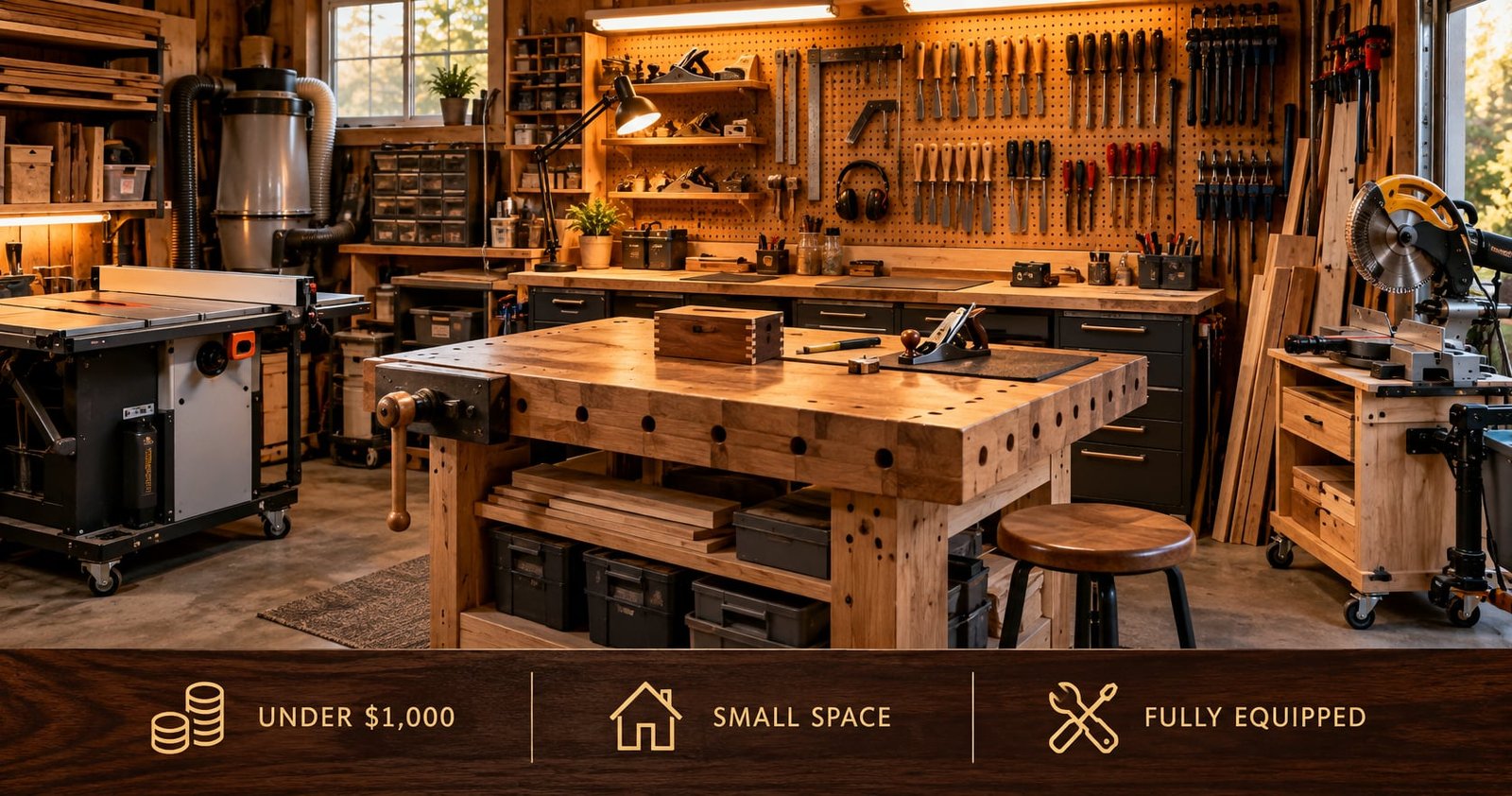
One of the biggest myths in woodworking is that you need a huge garage and thousands of dollars of machinery before you can really start. You do not. Plenty of woodworkers turn out beautiful, useful pieces from a corner of a basement, half a garage, a garden shed, or a space barely bigger than a parking spot. What matters is not how much room or money you throw at it, but how carefully you choose your space, your tools, and your layout. This guide walks through how to set up a small woodworking shop on a budget, the mistakes that quietly drain your wallet, and a complete blueprint if you want the whole thing mapped out for you.
The two roadblocks that stop most beginners
When people stall on setting up a shop, it almost always comes down to two worries: tools and space. They do not know which tools they actually need, so they either overspend on machines that sit in a box unused, or they buy the cheapest option and end up replacing it within a year. And they assume their space is too small or too awkward to work in, so they never start at all.
Both of these are solvable, and solving them is what turns “someday” into a working shop. Let us take them one at a time.
How much space do you really need?
Less than you think. A functional small shop can fit into a surprisingly tight footprint if it is planned well. A single-car garage, a basement corner, a shed, or even a sectioned-off part of a room can all become productive workspaces.
When you are choosing a space, weigh a few things:
- Power. You need accessible outlets, and ideally a circuit that can handle your tools without tripping. This is often the deciding factor.
- Ventilation. Woodworking makes dust and fumes, so you want a space you can air out or fit with dust control.
- Noise. If you share walls with neighbors or family, think about where sound will carry.
- Access. You need to get materials in and finished pieces out, so a reasonable doorway matters.
- Climate. Wood does not love big swings in temperature and humidity, so a space you can keep reasonably stable protects both your stock and your comfort.
A garage is the most common choice and usually a good one. A basement can be excellent if moisture is controlled. A shed works well as a dedicated space. Whatever you pick, the goal is a spot you can leave set up, so you are not packing everything away after each session.
Choosing the right tools without wasting money
This is where most of the money gets lost, in both directions. Buy too cheap and you replace tools constantly. Buy too much, chasing every “must-have” in the magazines, and you blow your budget on things you rarely touch.
The smarter path is to start with a short list of genuinely useful tools and add as your projects demand. You can build an enormous range of projects with a modest kit. A sensible starting point includes a way to measure and mark accurately, a way to cut (a hand saw plus a circular saw or jigsaw to begin), a cordless drill, a few clamps, a chisel or two, and a sander. Add a router, a table saw, or specialty tools later, when a project actually calls for them. Our guide to the essential woodworking tools for beginners breaks down exactly what to buy first and in what order.
On quality, aim for the middle. The rock-bottom discount tools often cost you more in the long run through frustration and early failure, while the top-of-the-line professional gear is usually overkill for a home hobbyist. Solid mid-range tools from reputable makers hit the sweet spot, and buying them deliberately rather than impulsively is how you set up a complete shop for well under $1,000.
Laying out a small shop so it works like a big one
A clever layout is what makes a small space feel twice its size. A few principles do most of the work.
Put things on wheels. The single best trick for a small shop is to make your heavier tools mobile. A tool on a lockable mobile base can be rolled out when you need it and tucked against a wall when you do not, so one small floor area serves many purposes.
Build up, not out. Walls are free real estate. Use pegboard, shelves, French cleats, and cabinets to get tools and supplies off the floor and off the bench, within easy reach but out of the way.
Create simple zones. Even in a tiny shop, roughly grouping your space into cutting, assembly, and finishing areas keeps you from constantly reorganizing mid-project.
Make your bench the heart of it. Position your workbench where you have room to work around it and good light overhead, since it is where you will spend most of your time. For more ideas, see our guide to small workshop layout and tool storage.
Light, power, dust, and safety
These unglamorous details make the difference between a shop you enjoy and one you avoid.
Lighting. You need to see your lines, your blades, and your hands clearly. Bright overhead LED shop lights plus a task light at the bench are cheap, and good lighting improves both accuracy and safety more than almost anything else.
Power. Know what your circuit can handle, avoid daisy-chaining extension cords, and route cables so you are not tripping over them, which is one of the most common causes of shop injuries.
Dust. Fine wood dust is bad for your lungs and makes a space unpleasant. A shop vacuum connected to your sanders and saws captures much of it at the source, and good airflow handles the rest. A dust mask or respirator is cheap insurance.
Safety. Keep a tidy shop, know where your first aid kit and fire extinguisher are, unplug tools when changing blades, and never rush a cut. A small shop can be every bit as safe as a large one when you build good habits in from day one.
The blueprint: the Ultimate Small Shop guide
If you would rather follow a complete, step-by-step plan than piece it all together yourself, there is a guide built for exactly this. The Ultimate Small Shop guide by Ralph Chapman, a woodworker with more than 25 years of experience, walks you through setting up a fully functional workshop on a budget, even in a very small space.
It is a 246-page illustrated guide organized into six modules, one for each part of building a shop:
- Tool selection, including specific shopping lists for hand-tool-only and power-tool budgets, and where to buy quality tools affordably
- Space selection, comparing garages, basements, sheds, and more, with the pros and cons of each so you choose well the first time
- Shop layouts, with floor plans and diagrams for spaces 10 by 10 feet and smaller, showing where to put everything for the best workflow
- Electricity, lighting, and soundproofing, covering cost-effective ways to light and power your shop and keep the noise down
- Heating, cooling, ventilation, and dust, so you can work in comfort and keep the air clean
- Workshop safety, with a practical checklist to protect your shop, your home, and your hands
The part most people find genuinely valuable is the tool and supplier guidance: a clear list of what to buy and where to find it at a good price, which can save you far more than the guide costs. It comes with two bonuses, a “Workshop Cheat List” for buying lumber and tools at discounts, and a deal-alert service, and it is backed by a 60-day money-back guarantee, so you can read the whole thing and decide risk-free.
At its current price of around $29 with that guarantee, it is an easy call for anyone about to spend hundreds on tools and a shop setup. If it saves you from even one wasted purchase, it has paid for itself.
You can start smaller than you think
The dream of a perfect workshop keeps a lot of people from ever starting, because they are waiting for more space or more money that never quite arrives. You do not need either. Pick a space you can leave set up, buy a short list of good mid-range tools rather than everything at once, put your heavy tools on wheels, light the space well, and build in safe habits from the start. Do that and you will have a real, working shop you are proud of, for a fraction of what most people assume it costs.
And if you want the whole thing laid out for you, module by module, with the tool lists and layouts done for you, the Ultimate Small Shop guide below is the shortcut.
Frequently asked questions
How much does it cost to set up a small woodworking shop? You can set up a genuinely functional shop for under $1,000, and even less if you start with hand tools and add power tools over time. The key is buying a short list of good tools deliberately rather than overspending on machines you will rarely use.
How much space do I need for a woodworking shop? Less than most people think. A single-car garage, a basement corner, or a shed is plenty, and with a smart layout you can work comfortably in a space around 10 by 10 feet or even smaller.
What tools do I need to start woodworking? Begin with the essentials: a way to measure and mark, a saw, a drill, a few clamps, a chisel, and a sander. Add a router, table saw, or specialty tools only when a project calls for them.
Is the Ultimate Small Shop guide worth it? At around $29 with a 60-day money-back guarantee, the risk is minimal, and the tool and supplier lists alone can save you far more than the price. If it does not help, you can request a refund.