Affiliate Disclaimer: This post contains affiliate links. If you buy through them, we may earn a small commission at no extra cost to you. We only recommend products we genuinely believe can help you.
Ask most woodworkers what stops them from building more, and they will not say skill or tools. They will say they ran out of ideas, or they got tired of hunting for the next decent project. You finish a piece, feel great about it, and then the shop goes quiet for a month because you cannot decide what to make next. By the time you settle on something, the momentum is gone.
That gap between projects is where a lot of woodworking hobbies quietly fade. Not from a lack of interest, but from a lack of a pipeline. This article is about fixing that. We will run through woodworking project ideas for every skill level and season, look at why chasing free plans one at a time keeps you stuck, and explain what a large, organized plans library gives you that scattered blueprints never will.
The real reason woodworkers run out of steam
Motivation in the shop feeds on momentum. When you always know what you are building next, you stay in a rhythm. You buy materials with a purpose, you keep your tools sharp because you are using them, and your skills climb steadily because you are building often. The projects stack up and so does your confidence.
Break that rhythm and everything cools. The decision of what to build next turns into a research project. You open a browser, you scroll through a few plan sites, nothing quite grabs you, and an hour later you have closed the laptop without a plan. Do that two or three weekends in a row and the hobby stalls, not because you stopped caring, but because the friction of finding a good project became bigger than the pull to build one.
The fix is boring but powerful: always have your next several projects lined up and ready to go. A builder with a deep well of vetted project ideas never faces that cold start. That is the whole case for keeping a broad library of woodworking blueprints within reach.
Woodworking project ideas for every skill level and season
To prove there is never a real shortage of things to build, here is a running list of project ideas across categories. Bookmark it and you will never stare at an empty bench wondering what to do.
Weekend woodworking projects for beginners. Birdhouses, simple wall shelves, a basic tool tote, cutting boards, a planter box, a phone stand, or a set of coasters. These build core skills like measuring, cutting square, and finishing, and each one can be done in a day.
Home furniture projects. A coffee table, a bookshelf, a nightstand, a bench for the entryway, a farmhouse dining table, or a simple platform bed. These teach joinery and give you pieces you actually live with, which is its own kind of reward.
Outdoor and patio builds. Adirondack chairs, a picnic table, raised garden beds, a potting bench, a porch swing, or a deck box. Outdoor projects are perfect for warmer months and make great gifts for family who admire your work.
Storage and workshop upgrades. Garage shelving, a lumber rack, a miter saw station, wall cabinets, a clamp rack, or a rolling tool cart. Building for your own shop pays you back every time you walk into it.
Small woodcraft and gifts. Jewelry boxes, keepsake boxes, wooden toys, picture frames, spice racks, or a wine rack. Small projects use offcuts, sharpen your detail work, and clear out the scrap pile.
Seasonal and holiday projects. Wooden ornaments, a advent-style gift, serving trays for gatherings, or a toy build ahead of the holidays. Seasonal work keeps the shop busy year round and gives your builds a deadline, which is often exactly the nudge you need.
Notice something about that list. It is long, and it barely scratches the surface. Ideas are not the shortage. Complete, ready-to-build plans for all of those ideas, sitting in one place, is the shortage.
The problem with hunting for free plans one at a time
Finding a single free plan is easy. Building a steady practice on free plans is where it falls apart. When you source projects one at a time, you pay a hidden tax every single time:
- The search tax. Every new project starts with a fresh hunt across different sites, formats, and quality levels.
- The vetting tax. You cannot trust a random plan until you have checked it for a real cut list, honest measurements, and clear steps. That check takes time, and beginners often cannot spot the gaps until they are already stuck.
- The consistency tax. Every source formats plans differently, so you never build a rhythm. One plan uses metric, the next uses imperial, one has diagrams, the next has none.
- The dead-end tax. Free plans disappear. Sites go down, links break, and the great plan you bookmarked last year is gone when you finally want to build it.
None of these taxes is huge on its own. Together, over a year of building, they add up to dozens of lost shop hours and a lot of stalled weekends. The scattered approach quietly works against the exact momentum that keeps the hobby alive.
What a massive woodworking plans library gives you
A large, organized collection flips the whole equation. Instead of starting each project with a search, you start with a browse through plans you already own, all formatted the same way, all built to the same standard. The difference in day-to-day building is bigger than it sounds:
- You always have a next project. The cold start disappears. Finish one build and the next three are already waiting.
- Everything is consistent. Same format, same level of detail, so you build faster because you are not relearning how to read a plan every time.
- You can match your mood and season. Feel like a quick win? Grab a small build. Ready for a challenge? There is a furniture piece waiting. Warm weekend? Browse the outdoor section.
- Your plans do not vanish. Downloaded, organized, and yours to keep, so a project you skip this year is still there next year.
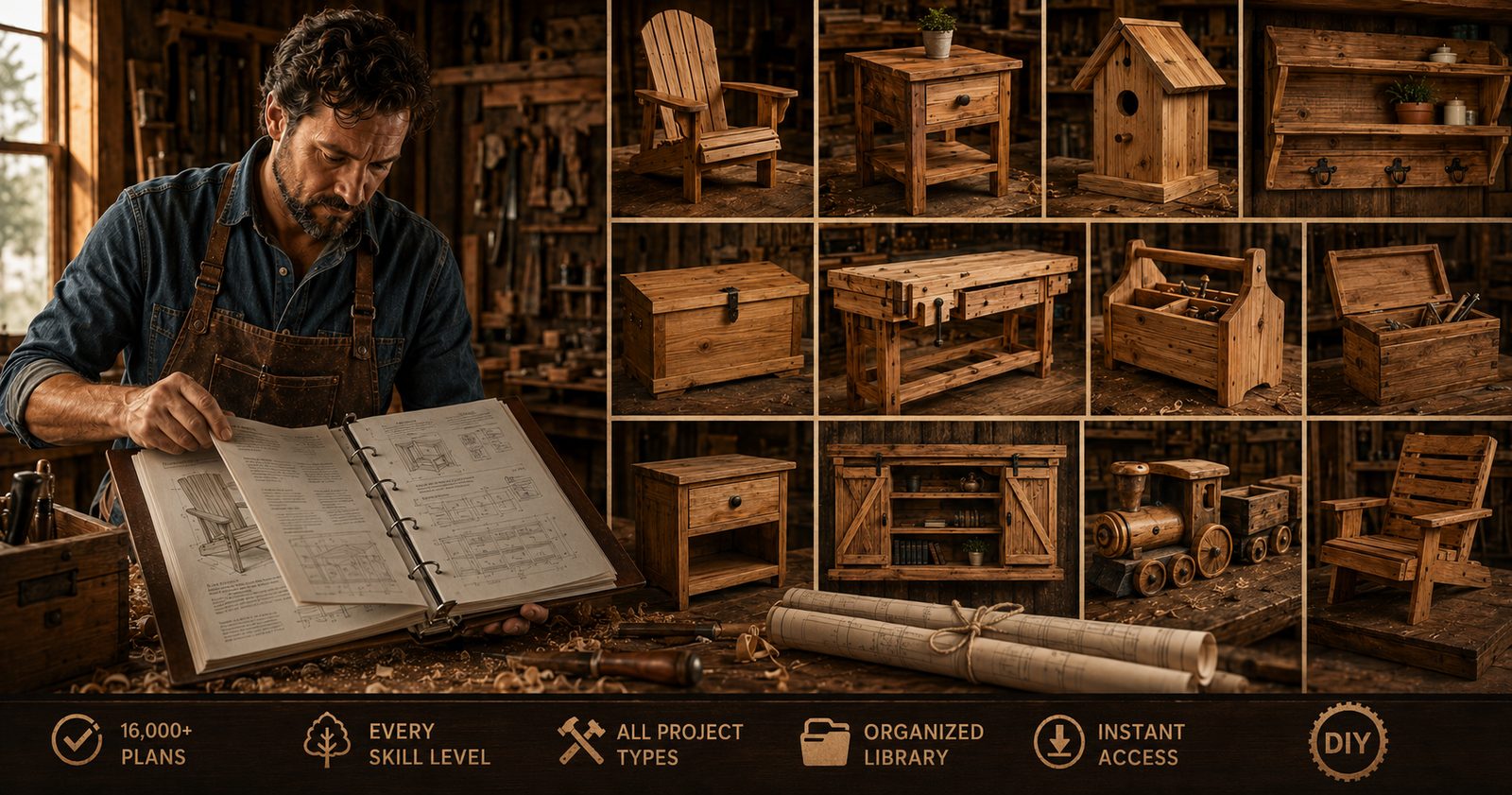
The best-known collection of this kind is Ted’s Woodworking, and it is popular for exactly this reason. It is a very large library of complete plans covering nearly every category above, put together specifically so builders never have to go hunting again.
Browse the Full Plans Library →
Inside Ted’s Woodworking: a closer look
Ted’s Woodworking is a digital library assembled by woodworker Ted McGrath. The core idea is one many builders arrive at eventually: rather than buying plans piecemeal or trusting scattered free downloads, you get one enormous, categorized collection you can pull from for years.
What stands out when you actually use a collection like this:
- Range that outlasts you. The library spans thousands of projects across furniture, outdoor builds, storage, small woodcraft, and more, which is far more than any single woodworker will realistically build in a lifetime. That is the point. You will never run dry.
- Complete blueprints. The plans are built to include cut lists, measurements, and step-by-step guidance with diagrams, so each one is genuinely buildable rather than a rough sketch of an idea.
- Sorted so the size is a feature, not a burden. Because projects are organized by category and difficulty, a huge collection stays usable. You filter to what you want instead of scrolling forever.
- Yours to keep and print. As a download, it is available instantly and stays on your machine, so your project pipeline does not depend on a website staying online.
In fairness, a library this large is not for everyone. If you are a once-a-year builder, you do not need thousands of plans, and a single project plan will serve you fine. And on day one the volume can feel like a lot, which is why the right approach is to ignore the grand total and simply pick your next one or two builds. But if you build regularly, or you want to, having a deep and organized well of projects is one of the most reliable ways to keep the momentum going.
How to plan a full year of builds from one library
Having a big library only helps if you use it with a little structure. Here is a simple way to turn a collection into a year of finished projects:
- Pick a theme per season. Outdoor builds in spring and summer, gifts and small woodcraft heading into the holidays, furniture and shop upgrades in the colder months when you are inside anyway.
- Line up three projects at a time. Always know your current build plus the next two. The moment you finish one, you slot the next in with zero downtime.
- Alternate hard and easy. Follow a demanding furniture build with a quick weekend win. It keeps morale up and prevents burnout on any single ambitious piece.
- Keep a build journal. Note what you learned on each project. Over a year you will see your skills climb, and that record makes the next plan easier to tackle.
Do this for twelve months and you will look back on a shelf, a garage, and a family full of pieces you made, rather than a hobby that stalled out in February.
Frequently asked questions
How many woodworking plans do I really need? More than you think, if you build often. The value of a large library is not building every plan. It is never facing a cold start, and always being able to match a project to your mood, season, and skill.
Are the projects suitable for beginners and advanced builders? A good broad library covers both, sorted by difficulty. Beginners filter to simple builds and work up, while experienced woodworkers dig into furniture and detailed pieces.
Is a plans library better than free plans? For occasional builders, free plans are fine. For anyone building regularly, an organized library removes the search, vetting, and consistency costs that quietly drain your shop time.
Will I actually use thousands of plans? You will not build them all, and that is fine. The breadth is insurance against ever running out of ideas or having to go hunting again.
The bottom line
Woodworking hobbies rarely die from a lack of skill. They fade in the quiet gaps between projects, when finding the next good build becomes more effort than starting it. The most dependable way to keep building is to remove that friction entirely by keeping a deep, organized well of projects within arm’s reach.
You can assemble that well slowly from free plans, paying the search and vetting tax each time, or you can get a large ready-made library like Ted’s Woodworking and spend your weekends building instead of browsing. Either way, the goal is the same: always know what you are making next, and never let the shop go cold.