
Affiliate Disclaimer: This post contains affiliate links, and as an Amazon Associate we earn from qualifying purchases. If you buy through our links, we may earn a small commission at no extra cost to you. We only recommend products we genuinely believe you will enjoy.
Woodworking is one of the most rewarding things you can do with your hands. It is also a hobby that involves sharp blades, fast-spinning machines, and materials that can hurt you if you are careless. The good news is that almost every woodworking injury is preventable. Safety is not about fear, and it is not about slowing you down. It is a set of simple habits that, once they become second nature, let you focus on the fun part with confidence.
This guide walks through the safety basics every woodworker should know, from the gear you wear to the way you handle tools, materials, and your workshop. None of it is complicated. Read it once, put the habits into practice, and they will quickly become automatic.
Please note: this page offers general guidance and is not a substitute for the instructions and safety warnings that come with your specific tools. Always read and follow the manufacturer’s directions, and see our Disclaimer for more.
Start with the right mindset
The single most important safety habit is respect for your tools. A table saw or a sharp chisel does not know the difference between wood and a finger. It simply does what it is built to do. When you treat every tool as capable of causing harm, you naturally slow down at the right moments, keep your hands where they belong, and think each cut through before you make it.
Most accidents do not happen because someone did something wildly reckless. They happen in small, ordinary moments: a rushed cut at the end of a long session, a guard left off just this once, a hand reaching toward a blade that has not fully stopped. Staying safe is mostly about paying attention and not cutting corners, especially when you are tired or in a hurry.
Wear the right protection
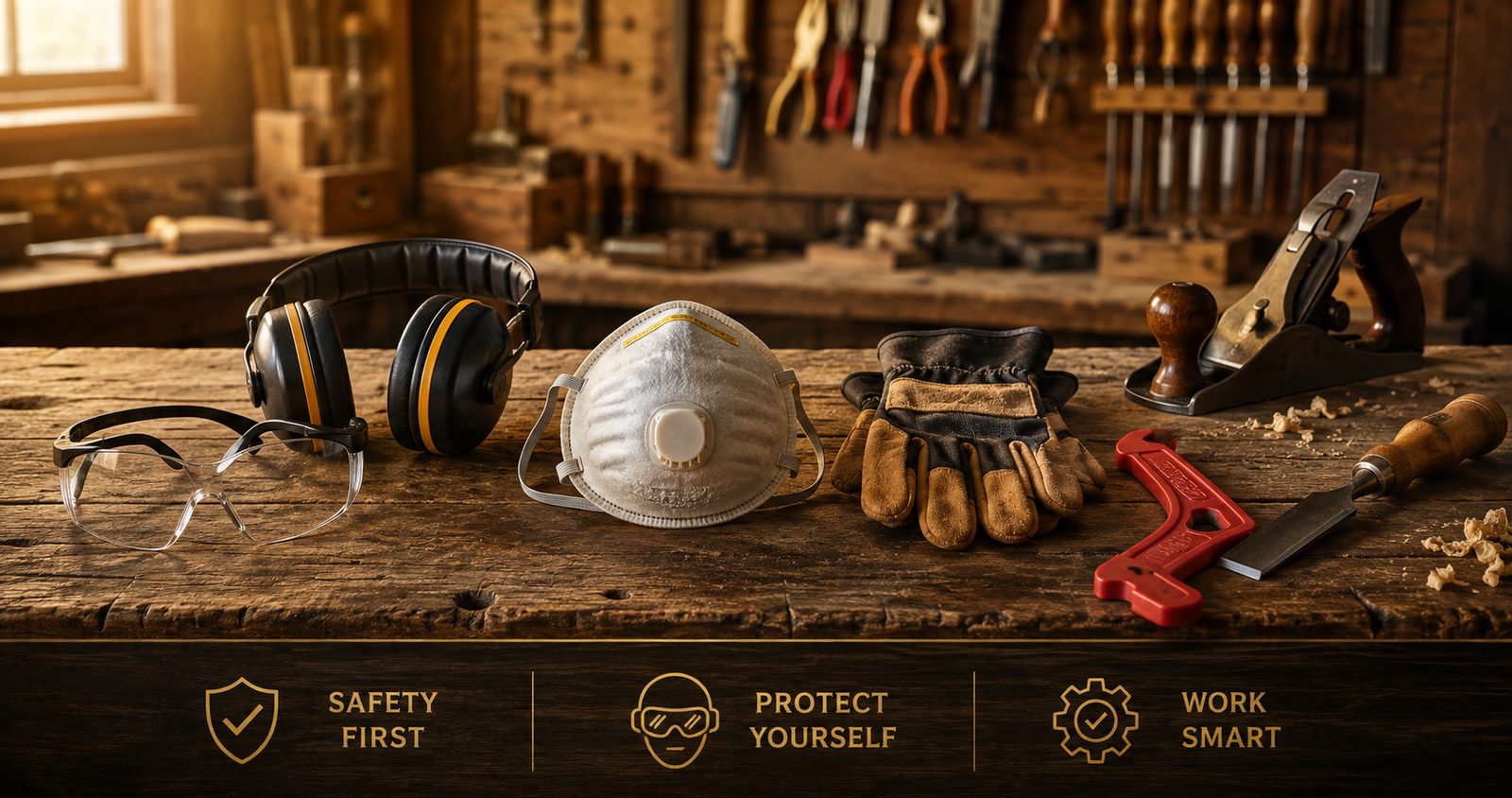
A few pieces of basic safety gear prevent the majority of common injuries. None of it is expensive, and all of it is worth having before you start.
- Eye protection. Safety glasses or goggles should be worn any time you cut, sand, chisel, or hammer. Wood chips, splinters, and dust fly up fast and without warning. This is the one piece of gear you should never skip, even for quick jobs, and it is especially important if you wear contact lenses.
- Hearing protection. Many power tools, including table saws, routers, and planers, run loud enough to damage your hearing over time. Earplugs or earmuffs are cheap and easy, and your ears will thank you years down the road.
- A dust mask or respirator. Fine wood dust is bad for your lungs, and some species can trigger allergies or irritation. A proper dust mask, or better yet a respirator rated for fine particles, protects you while sanding and cutting. There is more on dust further down.
- Sensible clothing. Roll up loose sleeves, tuck in anything that dangles, remove rings and bracelets, and tie back long hair. Anything that can catch in a moving tool is a hazard. Wear closed-toe shoes, ideally sturdy ones, since dropped boards and tools are a real risk to bare feet.
A quick word about gloves
Gloves are one of the few pieces of safety gear that can help or hurt depending on the task, so it is worth being clear. Never wear loose gloves around spinning power tools such as a table saw, drill press, router, or lathe. If a glove catches on a rotating blade or bit, it can pull your hand straight into the danger. For machine work, bare hands with good technique are safer.
Hand carving and whittling are the exception. When you are carving with a knife, a cut-resistant glove on the hand holding the wood, along with a thumb guard, are genuinely useful protection against slips. The rule of thumb is simple: gloves for hand tools where nothing is spinning, and bare hands for powered machines.
Set up a safe workshop
A safe shop is a tidy, well-lit shop. A cluttered floor and bench are more than an annoyance. They are a tripping hazard and a distraction, and both cause accidents. Make a habit of clearing offcuts and sweeping up sawdust as you go, and keep your walkways clear.
Good lighting matters more than people expect. You need to see your layout lines, your blade, and your hands clearly. Shadows and dim corners lead to mistakes, so add a bright overhead light and a task light at the bench if you can.
Keep your tools organized and within reach so you are not stretching awkwardly across a running machine to grab something. Store hand tools with their edges protected, and keep small hardware sorted so you are not rummaging mid-task. A stable, solid workbench that does not rock or slide is the foundation of safe work, since a moving surface throws off your control.
Finally, keep a first aid kit in the shop and know exactly where it is, keep a fire extinguisher nearby, and make sure children and pets stay out while you are working. If you use power tools, make sure your outlets and extension cords are up to the job, and route cords so they cannot snag your feet or your workpiece.
Know your tools before you use them
Every new tool comes with a manual for a reason. Read it. It tells you how the tool is meant to be used, what its safety features do, and what not to do with it. A few minutes of reading, plus a dry run with the tool unplugged so you can feel the motions, saves you from learning the hard way.
Beyond that, a handful of principles apply to almost every tool:
- Use the right tool for the job. Forcing a tool to do something it was not designed for is a common cause of both ruined work and injury.
- Keep the guards on. Blade guards, riving knives, and other safety features are there to protect you. Removing them to save a little time is one of the most dangerous habits in woodworking.
- Keep blades and bits sharp. This surprises beginners, but a dull blade is more dangerous than a sharp one. A dull edge forces you to push harder, which is exactly when tools slip, bind, and kick back. Sharp tools cut cleanly with less effort and more control.
- Unplug before you change anything. Always disconnect power before changing a blade, a bit, or a setting. Switches can fail, and a tool that comes on unexpectedly while your fingers are near the blade is a nightmare that is entirely avoidable.
- Inspect before you cut. Check that blades are tight, guards are in place, and the workpiece is free of nails, screws, or loose knots that could catch or fly.
Staying safe with hand tools
Hand tools feel gentler than machines, but chisels, carving knives, and saws are sharp and account for plenty of injuries. The core rule is to always cut away from your body and away from your hands. Plan where the blade will go if it slips, and make sure nothing important is in that path.
Secure your work before you cut. A piece held down with a clamp or a vise stays put, which means you can use both hands to control the tool, and you are not tempted to hold the wood with a hand that sits in the cutting path. Keep your hand tools sharp for the same reason as power tools, since a dull chisel that has to be forced is far more likely to slip.
Staying safe with power tools
Power tools do the hard work quickly, which is exactly why they demand your full attention. A few habits keep them from turning on you.
Secure the workpiece and keep your hands well clear of the blade or bit. Never cut freehand on a machine that expects the work to be guided against a fence or guard. Use push sticks and push blocks to keep your fingers out of the danger zone when feeding small or narrow pieces. Know where the off switch is before you start a cut, and make sure you can reach it without reaching across the blade.
Let the tool come to a complete stop before you reach in, clear offcuts, or set it down. A blade that is still coasting can still do serious damage, and this is one of the most commonly overlooked mistakes. Keep your eyes on your work from start to finish. Looking away to check your phone or answer someone is how hands meet blades, so finish the cut first, then look up.
If a cut suddenly feels wrong, if the tool starts to bind, or if something does not sound right, stop and find out why rather than forcing it. Forcing a stuck cut is a classic cause of kickback and slips. Take a breath, solve the problem, and continue only when it is sorted.
The table saw deserves special respect
The table saw is one of the most useful machines in a shop and also one of the most frequently involved in serious injuries, so it is worth calling out on its own. The biggest danger is kickback, which happens when the wood binds against the blade and gets thrown back toward you at high speed, sometimes taking a hand with it.
To reduce the risk, keep the riving knife or splitter and the blade guard in place, since they help stop the wood from pinching the blade. Always guide your workpiece against the fence or a miter gauge rather than cutting freehand, but do not use the fence and miter gauge together in a way that traps the offcut, as that invites a jam. Stand slightly to the side of the blade rather than directly behind it, so that if kickback happens you are not in the line of fire. Use a push stick for narrow cuts, keep your hands away from the blade’s path, and never reach over a spinning blade to clear a cutoff. Wait until it stops.
Protect your lungs from dust and fumes
Sawdust looks harmless, but the fine dust that woodworking produces is a real health hazard. Breathing it in over time can irritate your lungs and airways, and prolonged exposure to certain hardwood dusts has been linked to more serious respiratory problems. Some species are also known to cause allergic reactions or skin irritation.
Protect yourself by wearing a dust mask or respirator rated for fine particles while sanding and cutting, and by controlling dust at the source. A shop vacuum or dust collector connected to your tools captures much of it before it reaches the air. Good ventilation helps too, so open a window or run a fan when you can, and sweep or vacuum regularly so the fine dust does not build up and get stirred back into the air.
Finishes, stains, and solvents come with their own hazards. Many give off fumes you should not breathe in an enclosed space, and quite a few are flammable. Use them in a well-ventilated area, follow the safety directions on the label, and keep them away from any source of flame or sparks. Do not smoke around them.
The oily rag hazard most people miss
This one deserves its own mention because it surprises so many woodworkers. Rags soaked in oil finishes such as linseed oil or Danish oil can catch fire on their own, with no spark or flame at all. As the oil dries it gives off heat, and if that heat is trapped in a crumpled pile of rags, it can build up until the rags ignite. This is a genuine cause of shop fires.
The fix is easy. Never ball up oily rags and toss them in a bin. Instead, lay them out flat in a single layer to dry completely, ideally outside and away from anything flammable, or store them in a sealed metal container made for the purpose. Once they are fully dry and stiff, they are safe to throw away.
Handle your materials with care
The wood itself can bite back. Watch for splinters, and be careful with rough or reclaimed boards. Salvaged lumber can hide nails, screws, or staples that will damage your blades and can fly out dangerously, so inspect and clean old wood before cutting it. Be cautious with pressure-treated and chemically treated lumber as well, since the dust from it is not something you want to breathe, and follow any handling guidance that comes with it.
Loose or dead knots can pop out or cause a board to catch during a cut, so check your stock and plan around any weak spots. When in doubt, set a questionable board aside rather than risk it.
The most important safety tool is you
No guard or glove matters as much as your own judgment and attention. A large share of accidents come down to human factors that have nothing to do with the equipment.
Do not work when you are tired, rushed, or frustrated, because that is when mistakes happen. If you catch yourself hurrying to finish, take a break instead. Never use tools after drinking alcohol or taking anything that affects your focus or coordination. Wait to celebrate a finished project until the tools are switched off and put away. Keep distractions to a minimum, and if someone comes into the shop to talk, finish your cut and step away from the machine before you turn to them.
Think each cut through before you make it. Where are your hands going to be? Where will the blade go if it slips? What happens to the offcut? Running through those questions takes a second and prevents most of the situations that lead to injury.
Build good habits from day one
Safety is not a checklist you complete once. It is a set of small habits you repeat every time you step into the shop, until they become automatic and you do them without thinking. Put your glasses on before you turn anything on. Clamp your work. Keep your blades sharp. Unplug before you change a bit. Let the tool stop before you reach in. Clean up as you go.
Start slow, especially if you are new. Choose simple projects, get comfortable with each tool one at a time, and do not rush to take on something beyond your experience. The confidence that lets experienced woodworkers work quickly and safely is built on exactly these habits, and you get there the same way they did, one careful project at a time.
Respect your tools, protect yourself, stay focused, and woodworking will reward you with years of safe and satisfying builds. Now get out there and make something, carefully.