Affiliate Disclaimer: This post contains affiliate links. If you buy through them, we may earn a small commission at no extra cost to you. We only recommend products we genuinely believe can help you.
Starting a woodworking project should feel exciting. You have the wood, you have the weekend, and you have a clear picture in your head of the finished piece. Then you open the plan you found online, and everything stalls. The measurements do not quite add up. One step assumes you already know something nobody bothered to explain. Halfway through the build you realize the cut list left out a board, and now you are back at the hardware store instead of in the shop.
If any of that sounds familiar, here is the good news: the problem was probably never your skill. It was the plan. Good woodworking plans quietly do half the work for you. Bad ones turn a relaxing project into a guessing game that eats your time, your lumber, and your patience.
This guide walks through how to tell a solid woodworking plan from a weak one, the honest tradeoff between free and paid plans, and where beginners can find plans that actually get them to the finish line.
Why the right woodworking plans make or break a project
A woodworking plan is a blueprint. It tells you what to buy, how to cut it, and the order to put it together. When that blueprint is complete and accurate, you can move through a build with real confidence. You know your next cut before you make it, you know your joints will line up, and you know the finished piece will match the dimensions you expected.
When the plan is vague or incomplete, every one of those small certainties disappears. You start improvising. Sometimes improvising works out. More often it leads to a wobbly leg, a drawer that does not fit its opening, or a panel that ended up two inches short because the plan never listed the final dimensions.
The cost adds up fast. A single sheet of quality plywood is not cheap, and a mismeasured hardwood board can wipe out a good chunk of your project budget. Beyond the money, there is the time. Most of us get a few hours in the shop on a good weekend. Spending those hours untangling a bad plan instead of building is the real loss. Good plans protect the one resource you can never get back.
What a good woodworking plan actually includes
Once you know what to look for, you can spot a quality plan in about thirty seconds. Here is the short checklist every solid plan should tick off:
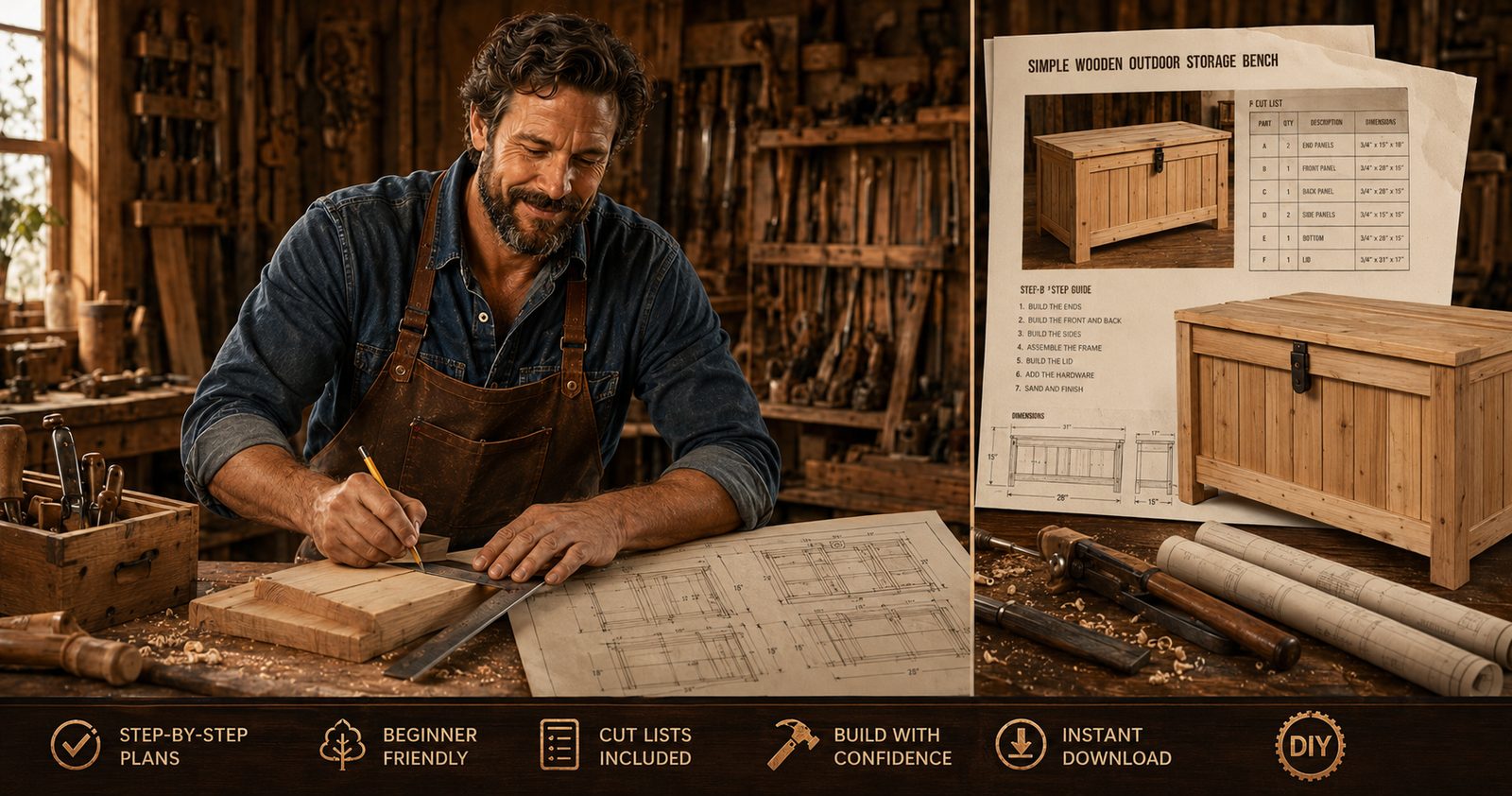
- A complete materials and cut list. Every board, every screw, every hinge, with quantities and dimensions. If you cannot build a shopping list straight from the plan, that is a red flag.
- Exact measurements, not rough guidance. Real numbers for every part, ideally in a clear cutting diagram so you can see how pieces come out of a board.
- Step-by-step instructions in the right order. Good plans build the way you actually assemble, one logical step at a time, with nothing skipped between step four and step five.
- Clear diagrams or exploded views. A picture that shows how the parts fit together is worth more than three paragraphs of text. Exploded views are the gold standard.
- A tool list up front. You want to know before you start whether the build needs a router or a pocket-hole jig, not discover it mid-project.
- A difficulty rating and finished dimensions. So you can match the project to your skill level and confirm the piece will fit the space you had in mind.
If a plan is missing two or three of these, keep looking. You are not being picky. You are saving yourself a frustrating afternoon.
Free woodworking plans versus paid plans: the honest tradeoff
Let us be fair to free plans, because plenty of them are genuinely good. There are talented woodworkers who share excellent free plans on their blogs and channels, and if you find one that ticks the checklist above, use it and enjoy it.
The catch with free plans is not quality on any single plan. It is consistency and time. Free plans are scattered across hundreds of sites, each with its own format, its own level of detail, and its own gaps. One plan gives you a full cut list but no diagrams. The next has beautiful diagrams but vague measurements. You end up spending as much time vetting and cross-checking plans as you do building. For a beginner who cannot yet spot the gaps until they are already stuck, that hunt gets expensive in mistakes.
Paid plans, and especially large organized collections, solve a different problem. You are not really paying for the plans themselves. You are paying for consistency, completeness, and the fact that everything sits in one place, formatted the same way, so you can go from idea to build without a research phase every single time. Whether that is worth it depends on how often you build and how much you value your shop time.
Where beginners can find woodworking plans they can trust
You have a few good routes. Woodworking books and magazines are reliable and well edited, though a single book only covers so many projects. YouTube is fantastic for watching technique, but video is a poor format for measurements you need to reference mid-cut. Free plan sites are hit or miss, as covered above.
Then there are comprehensive paid collections, and the best known of these for beginners is Ted’s Woodworking. It has become the go-to for people who want a huge range of complete, ready-to-build plans in one downloadable library rather than piecing projects together from a dozen sources. If the idea of never hunting for a decent plan again appeals to you, it is worth a look.
See What’s Inside Ted’s Woodworking →
An honest look at Ted’s Woodworking
Ted’s Woodworking is a large digital library of woodworking plans put together by Ted McGrath, a woodworker and educator. The pitch is simple: instead of buying plans one at a time or scouring the internet, you get access to a very large collection of plans across nearly every category a home woodworker cares about, all in one place.
Here is what tends to matter most about it in practice:
- Breadth. The collection spans thousands of projects, from small weekend builds like birdhouses and boxes to full furniture pieces, sheds, and outdoor sets. Whatever mood you are in, there is usually something to match it.
- Complete plans, not teasers. The plans are built to include the things that matter: cut lists, measurements, and step-by-step guidance with diagrams, which is exactly the checklist a good plan should meet.
- Organized by type and skill. Because everything is categorized, you can filter down to beginner-friendly projects instead of feeling lost in the volume.
- Instant access. It is a digital download, so you are building the same day rather than waiting on shipping.
Now the honest part, because a recommendation you can trust has to include the caveats. If you only build one small project a year, a giant library is probably more than you need, and a single free plan might do the job. The sheer number of plans can also feel overwhelming on day one, so the smart move is to ignore the total and just pick one beginner project to start. And if you are chasing ultra-premium plans from a specific designer, this is a broad general-purpose library rather than a boutique collection. For most hobbyists who want range, completeness, and one reliable source, though, that breadth is the entire point.
Who is it genuinely a good fit for? Beginners who want to build regularly and are tired of vetting random plans. Weekend woodworkers who like variety and hate research. Anyone who would rather spend Saturday in the shop than in seventeen browser tabs comparing cut lists.
Get Instant Access to the Plans Library →
How to get the most out of any plan you build
A great plan still rewards a little discipline. These habits will save you wood no matter where your plans come from:
- Read the whole plan before you cut anything. Understand the full build first. You will catch tricky steps early and avoid nasty surprises at step nine.
- Check the cut list against your own math. It takes two minutes and occasionally catches a typo before it costs you a board.
- Buy about ten percent extra material. Mistakes happen, grain has flaws, and running short mid-build kills momentum.
- Dry-fit before you glue. Assemble without glue or fasteners first to confirm everything lines up. This one habit prevents most permanent mistakes.
- Start below your ceiling. Pick a project one notch easier than you think you can handle. Finishing something builds far more skill than half-finishing something ambitious.
Three plan mistakes that quietly cost beginners the most
Even with a solid plan in hand, a few common habits trip up new woodworkers again and again. Knowing them in advance is half the battle.
Trusting the photo over the measurements. A beautiful finished photo tells you nothing about whether the plan is complete. Beginners often pick a project because the picture looks great, then discover the plan behind it is thin. Judge a plan by its cut list and diagrams, not its glamour shot.
Ignoring the tool list until it is too late. Few things kill a Saturday like getting three steps in and realizing you need a tool you do not own. Read the tool list first, every time. If a plan does not include one, that tells you something about how carefully it was written.
Scaling a plan up or down on the fly. It is tempting to take a bookshelf plan and just make it taller, or shrink a table to fit a smaller room. Changing dimensions affects joinery, material, and stability in ways that are easy to underestimate. Until you have a few builds behind you, build the plan as written, then modify once you understand why each measurement is what it is. This is another quiet argument for a large library: instead of forcing one plan to become something it is not, you can usually find a plan already sized close to what you want.
Frequently asked questions
Are woodworking plans worth paying for? If you build often, yes, because the time and lumber you save vetting and correcting free plans usually outweighs the cost quickly. If you build rarely, a well-chosen free plan may be all you need.
Can a complete beginner actually use these plans? Yes, as long as you start with beginner-rated projects and follow the read-first, dry-fit habits above. The right plan is what turns a beginner into a confident builder.
Do I need a shop full of expensive tools? Not to start. Many beginner projects need only basic hand and power tools. Always check the tool list on a plan before committing so there are no surprises.
Can I print the plans? Downloadable plans like the ones in Ted’s Woodworking are made to be printed, which is handy for keeping a marked-up copy at the bench instead of a phone screen covered in sawdust.
The bottom line
The single biggest upgrade most beginner woodworkers can make is not a new tool. It is better plans. Complete, accurate, well-organized plans remove the guesswork that causes almost every avoidable mistake, and they let you spend your shop time building instead of troubleshooting. Whether you gather great free plans one by one or get a full library in one place, hold every plan to the checklist in this guide and your projects will start turning out the way you pictured them.
If you want the shortcut, a comprehensive collection like Ted’s Woodworking puts thousands of complete, ready-to-build plans a click away, so your only real decision is what to build first.