
Affiliate Disclaimer: This post contains affiliate links, and as an Amazon Associate we earn from qualifying purchases. If you buy through our links, we may earn a small commission at no extra cost to you. We only recommend products we genuinely believe you will enjoy.
You do not need a big, dedicated shop to enjoy woodworking. A corner of a garage, a small shed, a basement, or even a spare room can become a workspace that is genuinely pleasant to work in. What matters far more than square footage is how you lay the space out and how you store your tools. A small shop that is organized beats a large one that is a cluttered mess every single time.
This guide walks through how to plan a small workshop, set up smart storage, and keep everything within reach, so you spend your time building instead of hunting for tools or clearing space to work.
Start by looking honestly at your space
Before you buy a single shelf, take stock of what you have. Measure your space, note where the doors, windows, and outlets are, and think about what you can and cannot move. A shared garage has different limits than a spare room, and a rented space may rule out drilling into walls. Working within your real constraints from the start saves a lot of frustration later.
Think too about how you will get materials in and finished pieces out, and whether the space needs to serve another purpose when you are not working. Many small-shop woodworkers build a setup that folds away or rolls to one side so the garage can still hold a car. There is no single right layout, only the one that fits your space and the kind of projects you want to make.
Think in zones
Even a small shop works better when you group activities into zones. You do not need much room for each, just a logical place for the main tasks. A typical setup has an area for measuring and cutting, an area for assembly and glue-ups, a spot for finishing, and storage for tools and materials around the edges.
The idea is to keep the things you use together near each other, and to keep a clear path between them. Your cutting area needs space for boards to feed through without hitting anything. Your assembly area needs a flat, open surface. Your finishing spot should be somewhere with decent ventilation and away from dust. Arranging these so you are not constantly walking back and forth or moving things out of the way makes a small shop feel much bigger than it is.
The workbench is the heart of the shop
If there is one thing to get right, it is your workbench. It is where you will do most of your measuring, assembly, and hand work, so it needs to be solid, flat, and at a comfortable height. A bench that rocks or slides around fights you on every task and can even be unsafe.
You can buy a workbench, but building your own is a rewarding early project and lets you make it exactly the size your space allows. Fitting it with a bench vise gives you a reliable way to hold work while you shape it. In a small shop, a workbench on lockable casters is worth considering, since being able to roll it out to work and tuck it back against the wall afterward transforms how usable a tight space is. If you would like a complete, proven plan to build one, a good plans library has workbench designs for every size of shop.
Get your tools off the floor and onto the walls
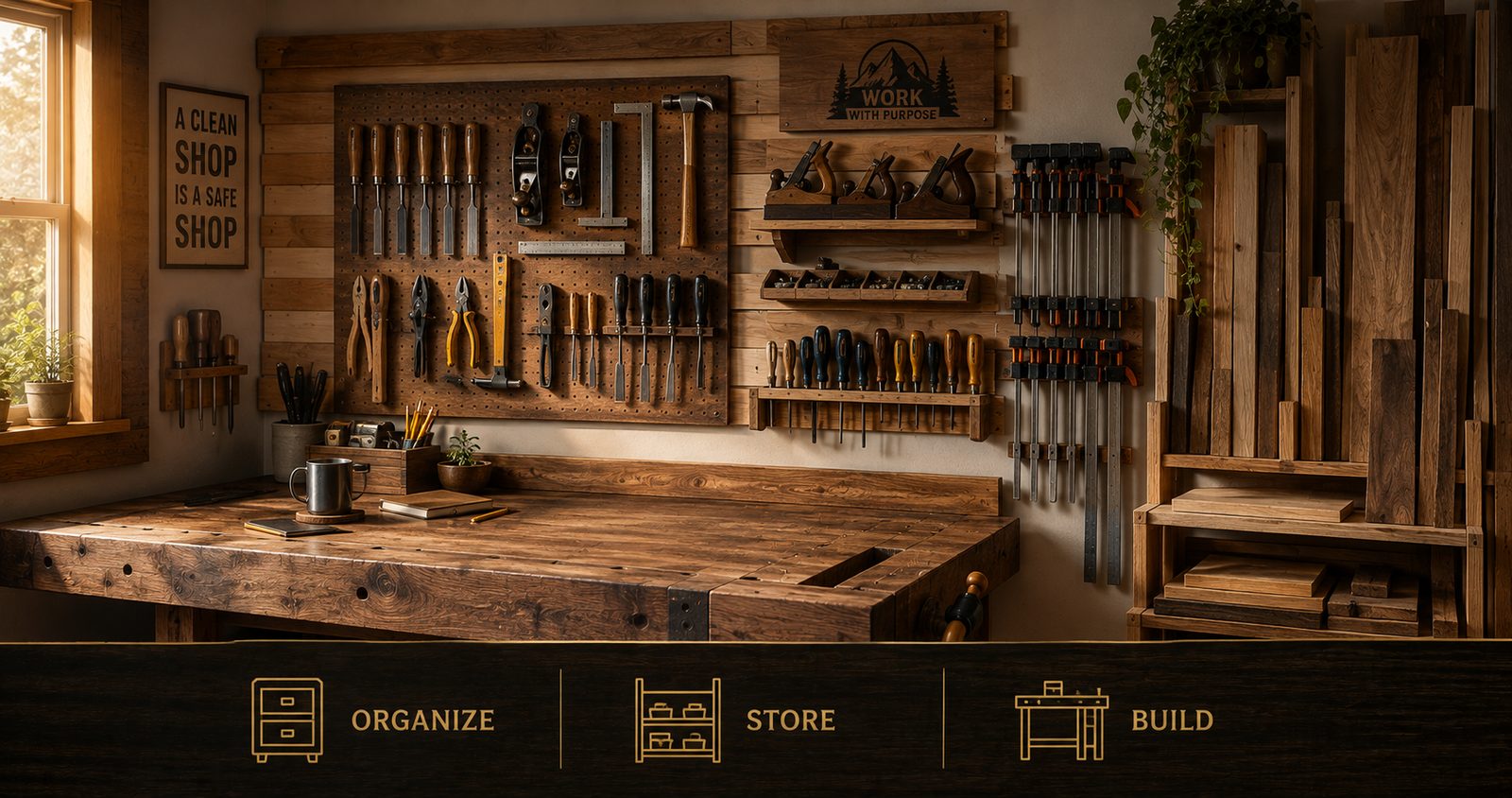
In a small shop, wall space is your best friend. Every tool hanging on a wall is a tool that is not taking up bench or floor space, and it is easy to find and grab. There are a few great ways to do this.
A pegboard is the classic, cheap, and flexible option. You hang tools on hooks and rearrange them whenever you like, and you can outline each tool so you always know where it goes. A french cleat wall is a step up that many woodworkers love. It uses angled strips on the wall that hold custom holders you can move around freely, which lets you build exactly the storage your tools need and change it as your collection grows. Simple shelves and a few wall-mounted racks round things out for clamps, hand tools, and supplies.
Smart tool storage keeps everything findable
Beyond the walls, a bit of enclosed storage keeps dust off your tools and small parts organized. A tool chest or a set of drawers is ideal for hand tools, bits, and hardware, keeping them clean and sorted so you are not rummaging mid-project. Small parts organizers with divided bins are perfect for screws, nails, and fittings, and labeling them saves you real time.
The guiding principle is simple. Store the things you use most within easy reach of where you use them, and give everything a home so putting it away is quick. A shop where every tool has a place is a shop that stays tidy, because tidying up is effortless.
Put things on wheels
The single best trick for a small shop is to make things mobile. Mobile bases under your larger tools and a rolling cart or two let you reconfigure the whole space in seconds. You can roll a tool out into the middle of the room to use it, then push it back against the wall when you are done, which means one small space can do the job of a much larger fixed layout. A rolling cart also doubles as an outfeed support and extra work surface when you need it.
Do not ignore dust
Dust is the enemy of a small, enclosed shop. It coats everything, it is bad for your lungs, and it makes the space unpleasant to work in. You do not need an elaborate system to manage it. A good shop vacuum connected to your sanders and saws captures much of the dust at the source, and a simple dust collector helps if you run larger tools. Keeping a vacuum handy and sweeping up as you go makes a big difference. Good dust control protects both your tools and your health, and it keeps your finishing area clean so your projects come out looking their best.
Light it well and plan your power
Good lighting turns a gloomy corner into a space you actually want to work in, and it is a safety essential, since you need to see your lines, your blades, and your hands clearly. Bright overhead shop lights plus a task light at the bench cover most needs, and they are inexpensive.
Plan your power too. Note where your outlets are and make sure you have enough of them where your tools live. Use proper extension cords rated for the job, and route cords so they cannot snag your feet or your workpiece. In a tight space, a power strip mounted at bench height and a retractable cord reel can keep things tidy and out of the way.
Store your lumber and offcuts
Wood takes up space, and a small pile can quickly become a big mess. A simple lumber rack on the wall keeps boards off the floor, flat, and organized, which also helps them stay straight. A bin or two for usable offcuts keeps small pieces handy without letting them take over, and it saves you money since you reach for scraps before buying new. Keep your wood indoors and dry so it stays stable and ready to use.
Use every inch of vertical space
When floor space is tight, the answer is almost always to build upward. The walls and even the area above head height can hold a surprising amount if you use it well. Tall, narrow shelving units store far more than wide, low ones for the same footprint. Overhead racks or shelves near the ceiling are perfect for things you use less often, like seasonal items, spare materials, or bulky jigs. Hanging your clamps on a wall rack, your hand tools on a cleat or pegboard, and your lumber on a wall rack clears the floor and the bench for actual work. In a small shop, thinking vertically is the single biggest space multiplier you have.
Make the space comfortable to work in
A shop you enjoy being in is a shop you will actually use, so a little comfort goes a long way. A anti-fatigue mat where you stand most saves your back and legs during long sessions. Some heating or a fan, depending on your climate, keeps the space usable year round. And keeping the noise and dust under control, with hearing protection and good dust collection, makes the whole experience more pleasant. These small touches turn a space you tolerate into one you look forward to, which matters more than it sounds for keeping the hobby alive.
Keep the floor clear and the shop safe
However you lay out your shop, keep the floor clear. Clutter and offcuts underfoot are a tripping hazard and a distraction, and both cause accidents. Sweep up as you go, keep your walkways open, and make sure your workbench and tools are stable. A first aid kit and a fire extinguisher belong in every shop, no matter how small. For a full rundown of working safely, see our woodworking safety guide.
Frequently asked questions
How small can a woodworking shop be? Smaller than you might think. A single-car garage, a corner of a room, a shed, or a basement can all work well. Smart layout, mobile tools, and good vertical storage matter far more than raw square footage.
What is the best way to store tools in a small shop? Get them off the floor and onto the walls. Pegboards and french cleat systems keep hand tools visible and within reach, while a tool chest or drawers keep bits and hardware sorted and dust-free.
How do I deal with dust in a small space? A shop vacuum connected to your sanders and saws captures most dust at the source, and sweeping up as you go keeps it under control. Good dust management protects both your tools and your lungs.
Should my tools be on wheels? In a small or shared shop, yes. Mobile bases and rolling carts let you roll tools out to use them and tuck them away afterward, so one small space can do the work of a much larger fixed layout.
Build the shop that fits your space
A great small workshop is not about having the most room. It is about making the room you have work hard for you. Plan your zones, build a solid bench, get your tools onto the walls, put the big stuff on wheels, control your dust, and light it well. Do that, and a modest corner becomes a space you look forward to spending time in.
Once your space is set up, the next step is filling it with projects. A big, organized library of woodworking plans gives you complete workbench, storage, and shop-organization builds with clear cut lists, so you can outfit your shop and keep building for years. Start with your bench, add storage as you go, and enjoy the simple pleasure of a workspace that is truly your own.