Affiliate Disclaimer: This post contains affiliate links. If you buy through our links, we may earn a commission at no extra cost to you. We only recommend products we genuinely believe can help you.
One of the fastest ways to go from wishing you could build something to actually building it is a good set of plans. A plan takes the guesswork out of a project, tells you exactly what wood and hardware to buy, and walks you step by step from a pile of boards to a finished piece. The best news for anyone starting out is that you do not have to pay for them. There are genuinely useful free woodworking plans out there, and this guide covers why plans matter so much for beginners, what separates a good plan from a frustrating one, the projects worth starting with, and where to get 50 free plans plus a 440-page guide book to go alongside them.
Why woodworking plans are a beginner’s best friend
When you are learning, a plan does far more than show you what to cut. It quietly teaches you the craft while you build something real.
They remove the guesswork. A good plan gives you exact measurements, the pieces to cut, and the order to assemble them in. Instead of staring at a board wondering where to begin, you follow clear steps and watch the project come together.
They teach you techniques. Every plan you build introduces skills you carry forward: how a joint goes together, how to square up a frame, how to attach a top so it will not crack as the wood moves. You learn by doing, with a safety net.
They prevent expensive mistakes. Wood is not cheap, and a single mismeasured cut on a nice hardwood board can wipe out a good part of your budget. A plan with a proper cut list keeps you from guessing, from buying too little, and from ruining boards you cannot easily replace.
They build confidence. There is nothing like finishing a real, useful object to make you believe you can build the next one. Plans let you start simple, succeed, and work up to more ambitious projects at your own pace.
What makes a good woodworking plan
Not all plans are created equal, and a bad one can turn a fun weekend into a frustrating mess. Before you commit to a project, check that the plan includes the essentials.
- Clear measurements and a cut list. Every piece should be listed with its dimensions, so you know exactly what to cut before you start. This is the single most important part of any plan.
- A complete materials and hardware list. The plan should tell you what wood, screws, hinges, glue, and finish you need, so you can buy everything in one trip instead of three.
- Step-by-step instructions in order. Good plans walk you through assembly logically, one stage at a time, rather than leaving you to work out the sequence yourself.
- Diagrams or exploded views. A clear drawing that shows how the parts fit together is worth a thousand words, especially when you are new.
- A tools list. Knowing what you need before you begin means no nasty surprises halfway through a build.
- A difficulty level. A note on whether a project suits a beginner helps you pick something you can actually finish, which keeps you motivated.
When a plan has all of this, building becomes a pleasure. When it is missing, you spend more time deciphering the plan than working wood.
The best beginner projects to build from plans
If you are just getting started, the right first project is simple, useful, and forgiving. Here are some of the best builds to look for plans for.
- A cutting board. Simple, quick, and a genuinely useful gift. A great confidence builder that teaches gluing and finishing.
- A floating shelf. Minimal tools, a clean result, and instant usefulness on any wall.
- A birdhouse or planter box. Small, cheap to make, and perfect for practicing cuts and joinery without much pressure.
- A simple stool or bench. Teaches you sturdy joinery and leaves you with something you will actually sit on.
- A storage box or crate. Practice square corners and clean assembly, then use it all over the house.
- A picture frame. Small and inexpensive, and it teaches accurate miter cuts that carry into bigger projects.
- A workbench. A popular first “real” project, since building the bench you will use for everything else is deeply satisfying.
Start with one or two of these, finish them, and you will have the skills and the confidence to take on bigger pieces.
Where to find free woodworking plans
You can find free plans scattered across woodworking blogs, forums, and community sites, and tool manufacturers sometimes publish them too. The trouble with hunting them down one at a time is that quality varies wildly, many are missing the cut list or the measurements, and you can spend more time searching than building.
A far easier approach is to grab a large, ready-made collection all at once, so you always have a project to reach for. That is exactly what the free bundle below gives you.
Get 50 free woodworking plans and a 440-page guide book
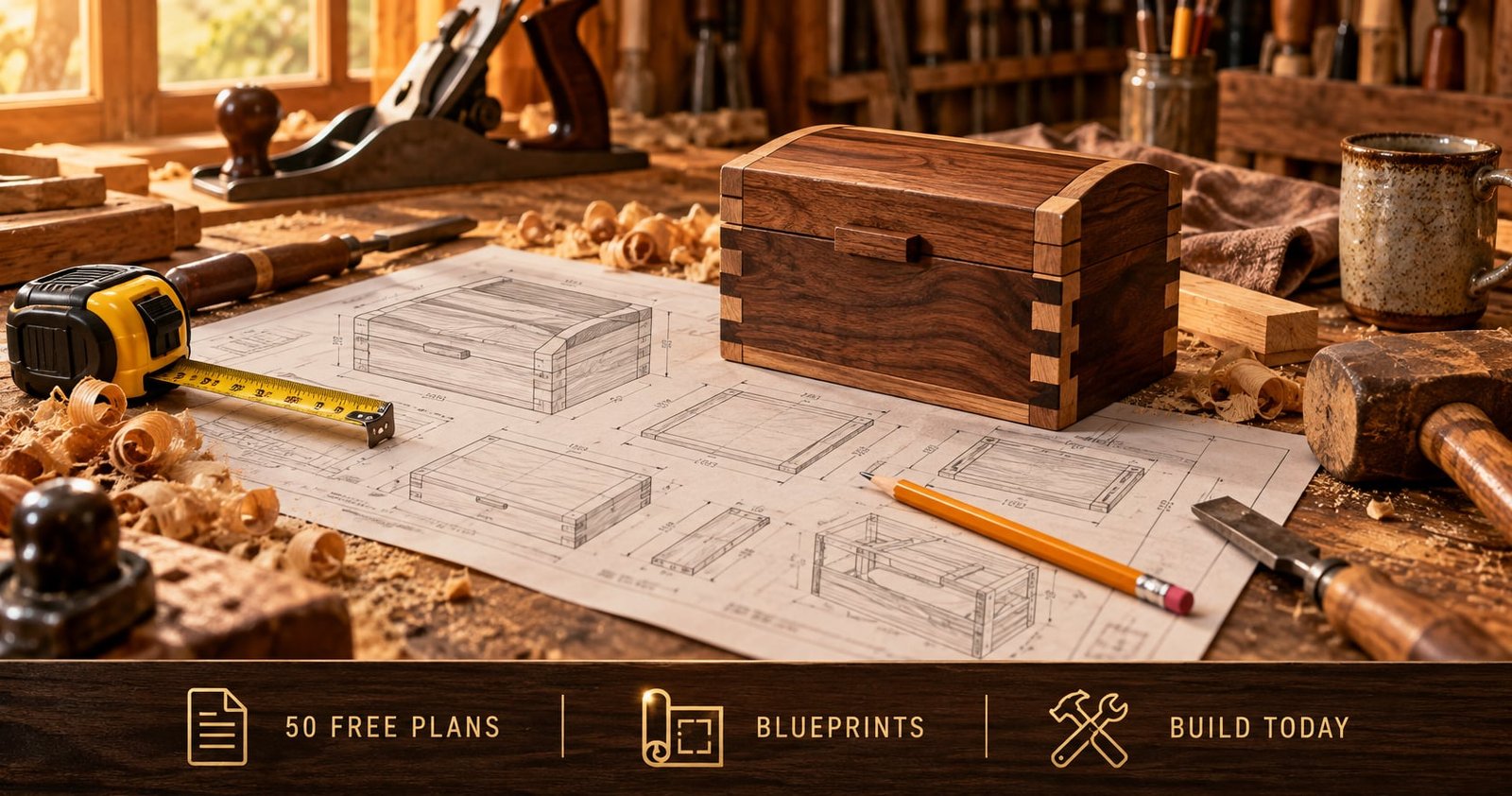
If you want a stack of beginner-friendly plans without paying a cent, there is a free bundle worth grabbing. You can download 50 free woodworking plans along with a 440-page guide book called “The Art of Woodworking,” plus a pile of extra tips, techniques, and videos for woodworkers.
Here is what is included:
- 50 step-by-step woodworking plans you can start building right away
- “The Art of Woodworking,” a 440-page guide book covering skills, techniques, and fundamentals
- Bonus tips, techniques, videos, and guides to help you keep improving
It is completely free. You simply enter your email and the plans and guide book are sent straight to your inbox, so you can start browsing projects within minutes. For a beginner, that is a huge head start: a whole library of projects and a reference book to learn from, at no cost and no risk.
How to get the most out of your plans
A plan is only as good as the way you use it. A few simple habits will make every build go smoother.
Read the whole plan first. Before you cut anything, read it from start to finish so you understand the full project and the order of steps. This alone prevents most beginner mistakes.
Check the cut list and buy once. Go through the materials and cut list, work out exactly what you need, and buy it in one trip. Running out of a board halfway through is a familiar frustration you can avoid.
Measure twice, cut once. It is an old saying because it is true. A careful measurement costs seconds. A wrong cut costs a board and sometimes the whole project.
Start with the simplest project that appeals to you. Pick something small and useful for your first build, finish it, and let that success carry you into the next one.
Keep your plans organized. Save the ones you like so you always have a project ready for a free weekend. A collection like the free bundle above gives you dozens to choose from in one place.
Once you have a few builds under your belt, you may want to go deeper. Our guides on essential tools for beginners and the best wood to start with pair perfectly with your new plans.
Frequently asked questions
Are free woodworking plans any good? Many are excellent, especially for beginners. The key is to choose plans that include clear measurements, a cut list, a materials list, and step-by-step instructions. A curated collection like the free bundle above saves you from sifting through low-quality ones.
What should I build first as a beginner? Start simple with something useful, such as a cutting board, a floating shelf, a small box, or a stool. Finishing an easy project teaches real skills and builds the confidence to take on bigger ones.
Do I need a lot of tools to build from plans? No. Many beginner plans need only a few basic tools. Each plan should list the tools required, so you can pick projects that match what you already own and add tools as you go.
Is the 50 free plans bundle really free? Yes. You enter your email and the 50 plans and the 440-page guide book are sent to you at no cost. It is a simple way to build a project library and a reference book without spending anything.
Plans are the shortcut from wanting to build to actually building, and there is no reason to pay for your first batch. Grab the free collection below, pick a simple project, and make some sawdust this weekend.