Affiliate Disclaimer: This post contains affiliate links, and as an Amazon Associate we earn from qualifying purchases. If you buy through our links, we may earn a small commission at no extra cost to you. We only recommend products we genuinely believe you will enjoy.
Walk into a lumberyard for the first time and it is easy to feel lost. There are dozens of types of wood, each with its own look, feel, price, and quirks, and it is not obvious which one you should buy for your project. The good news is that as a beginner you only need to know a handful of woods well. Choosing the right one makes your project easier to build, better looking, and longer lasting, and once you understand a few basics it stops being confusing.
This guide walks through the woods a beginner is most likely to use, what each is good for, and how to choose good boards at the store, so you can pick the right wood with confidence.
Softwood and hardwood: the basic split
Wood is broadly divided into softwoods and hardwoods, and the terms are a bit misleading. Softwoods come from evergreen, cone-bearing trees like pine, fir, and cedar, and they are generally cheaper, lighter, and easier to cut. Hardwoods come from leaf-shedding trees like oak, maple, and walnut, and they are usually denser, stronger, and more expensive. The names refer to the type of tree, not strictly how hard the wood is, but as a rough guide, softwoods are easier and cheaper to work while hardwoods are more durable and finish more beautifully.
Beginners usually start with softwoods because they are forgiving and inexpensive, then move to hardwoods as their skills and projects grow. Both have their place, and knowing when to use each is the real skill.
Pine: the beginner’s workhorse
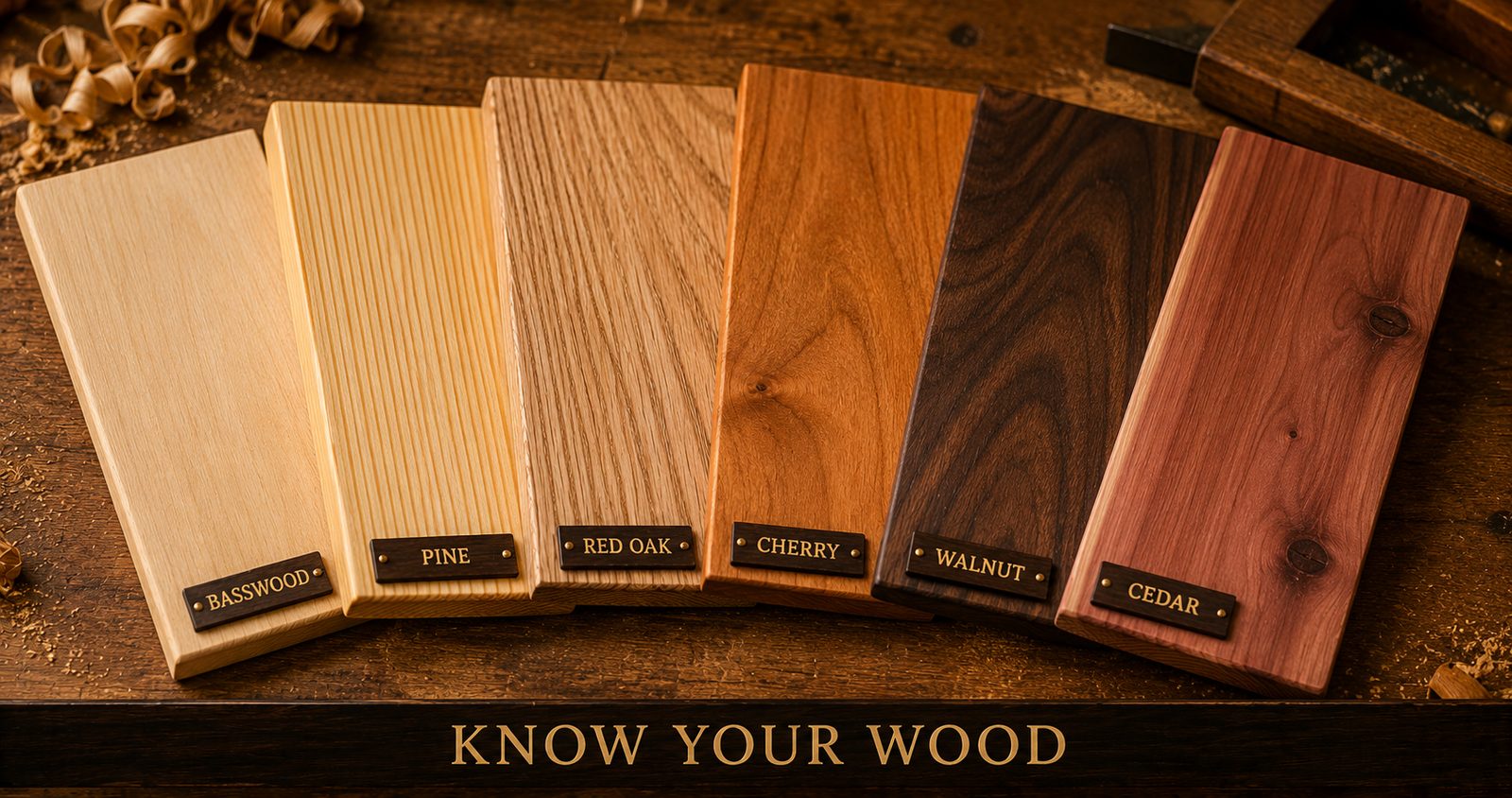
Pine is where most people start, and for good reason. It is cheap, sold everywhere, soft, and easy to cut, drill, and sand, even with basic tools. It is perfect for practice, for learning projects, and for anything you plan to paint. Its downsides are that it dents and scratches easily, since it is soft, and its grain can be uneven, with knots and sap that make staining tricky and blotchy. For rustic projects, shelves, simple furniture, and anything painted, pine is a great, affordable choice. Just buy the straightest, clearest boards you can and expect a few dings over time.
Basswood: the carver’s and burner’s favorite
Basswood is soft, pale, and has a fine, even, almost invisible grain, which makes it a joy to work by hand. It is the top choice for wood carving and whittling and for wood burning, because it cuts cleanly and takes detail and heat evenly. It is not a furniture wood, since it is soft and plain, but for carving, small crafts, and pyrography it is hard to beat. If you are getting into carving or burning, basswood is the wood to buy, and a good wood carving and whittling kit paired with a few basswood blocks is an inexpensive way to get started.
Poplar: cheap and paintable
Poplar is an affordable hardwood that is popular for painted projects. It is harder and more durable than pine but still easy to work, and it takes paint beautifully. Its natural color, which can range from cream to a greenish tint, is not the prettiest under a clear finish, which is why it is usually painted rather than stained. For painted furniture, trim, and projects where you want something sturdier than pine without the cost of premium hardwood, poplar is an excellent middle ground.
Oak: strong and classic
Oak is one of the most popular hardwoods for furniture, and it is often the first hardwood beginners try. It is strong, durable, and has a bold, attractive grain that looks great stained, since the open grain takes color and shows off dramatic patterns. Red oak in particular is widely available and relatively affordable for a hardwood. It is harder to cut and requires sharp tools and pilot holes for screws, but the results are worth it for furniture and pieces you want to last. Oak is a great step up once you are ready for hardwood.
Maple, cherry, and walnut
A few more hardwoods are worth knowing as you progress. Maple is hard, strong, and has a smooth, fine grain, which makes it excellent for durable items like cutting boards and furniture, though its hardness demands sharp tools. Cherry is a beautiful, moderately priced hardwood with a warm reddish tone that deepens gorgeously with age, prized for fine furniture. Walnut is a premium hardwood with a rich, dark chocolate color that needs no stain, used for heirloom pieces and accents. These are woods to grow into as your skills and budget allow, and they finish to a beauty that softwoods simply cannot match.
Cedar and redwood for outdoor projects
For anything that lives outside, cedar and redwood are the go-to choices. They naturally resist rot, moisture, and insects, which makes them ideal for planters, garden furniture, and outdoor decor. They are soft and easy to work, they smell wonderful, and they weather to a pleasant silvery gray if left unfinished. For outdoor builds, choosing a naturally weather-resistant wood like these, or using pressure-treated lumber, saves your project from falling apart in the elements.
Plywood and MDF: the sheet goods
Not all wood comes as solid boards. Plywood is made of thin layers glued together, which makes it strong, stable, and resistant to warping, and it is great for cabinet backs, drawer bottoms, shelves, and large flat panels. Better grades have an attractive face veneer you can finish. MDF is a smooth, dense manufactured board that is very flat and cheap, ideal for painted projects and panels, though it is heavy, does not hold screws well at edges, and must be kept dry. Both are useful to know, since they solve problems that solid wood does not, especially when you need large, stable flat pieces.
How to match the wood to the project
Choosing the right wood comes down to what the project needs. For practice and painted projects, reach for cheap, easy pine or poplar. For carving and burning, use basswood. For durable furniture you want to stain and keep, choose a hardwood like oak, maple, or cherry. For outdoor pieces, use cedar, redwood, or treated lumber. For large flat panels and hidden parts, use plywood or MDF. Matching the wood to the job is what makes a project turn out well, and it becomes second nature quickly.
Understanding wood grain
Grain is the pattern of lines you see running through a board, and it affects both how a wood looks and how it behaves. Wood is generally easier to cut and plane when you work with the grain rather than against it, since going against it tends to tear the fibers. Grain direction also matters for strength, as wood is much stronger along the grain than across it. Some woods, like oak and ash, have an open, dramatic grain that takes stain unevenly and creates bold patterns, while others, like maple and cherry, have a fine, closed grain that looks smooth and uniform. You do not need to master this on day one, but noticing grain direction as you work will quickly make your cutting cleaner and your projects stronger.
Making sense of lumber sizes and terms
The lumberyard has its own language, and a couple of points save beginners real confusion. The most important is that softwood boards are sold by a nominal size that is bigger than the actual size. A board called a two-by-four is not actually two inches by four inches once it has been planed smooth, it is closer to one and a half by three and a half inches. This catches everyone out at first, so always measure the real dimensions when your project needs to be precise. Hardwoods are often sold in quarters of an inch of thickness and in random widths and lengths, and sometimes by the board foot, which is a measure of volume. Do not worry about memorizing all of it. Just remember that the label size and the real size are not always the same, and measure to be sure.
Storing your wood so it stays usable
Wood moves as it absorbs and releases moisture, so how you store it matters. Keep your lumber indoors and dry, laid flat or stored on a rack so it does not sag or twist. Softwoods like pine tend to move more than hardwoods, so it is worth buying your wood a couple of weeks before you build and letting it sit in your shop to adjust to the conditions there. Keeping boards flat and supported prevents the warping and bowing that ruins otherwise good wood. A simple wall rack keeps everything organized, off the floor, and straight until you need it.
How to pick good boards at the store
Even within the right species, boards vary in quality, so a little care at the store saves you trouble. Sight down the length of each board with one end on the floor to check that it is straight and not warped or twisted. Look over both faces for long splits, large or loose knots, and cracks that would waste wood. Check that the color is reasonably even if the piece will be visible, and watch for any obvious damage. Do not feel obliged to take the first boards handed to you, since choosing good stock is normal and expected. A straight, sound board is far easier to work than a warped, knotty one.
A simple shortlist to start with
If you want the short version, here it is. Buy pine for practice and painted projects, basswood for carving and burning, poplar for sturdier painted work, oak for your first stained hardwood furniture, and cedar for outdoor builds, with plywood on hand for panels and backs. That small selection covers the vast majority of beginner projects, and you can add the premium hardwoods as your skills and confidence grow.
Frequently asked questions
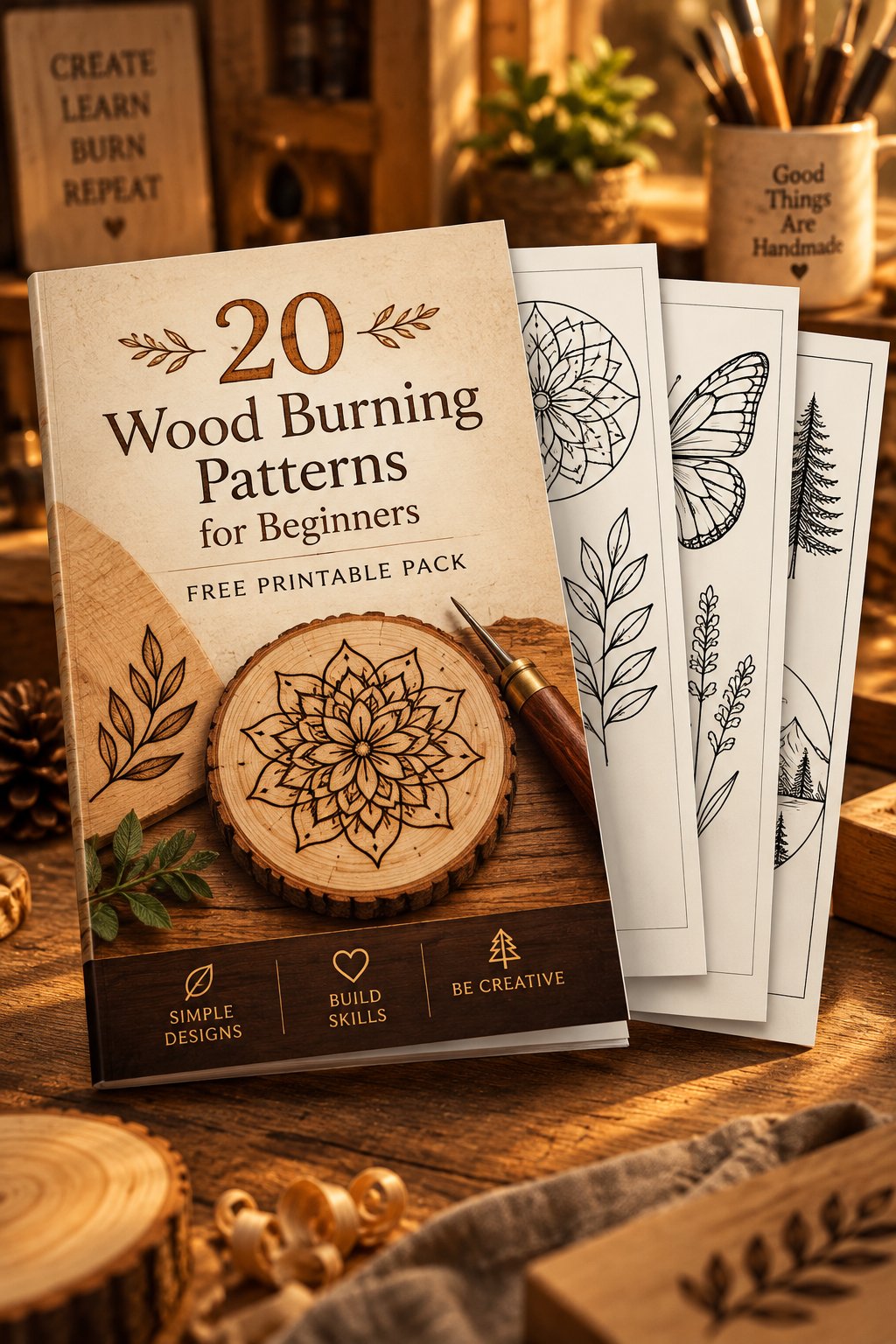
What is the best wood for a complete beginner? Pine is the usual starting point because it is cheap, easy to work, and available everywhere, which makes it perfect for practice and painted projects. For carving and wood burning, basswood is the top choice. If wood burning is what you are after, we have a free pack of twenty printable patterns to start with and a larger set of five hundred sorted from easiest to hardest.
What is the difference between softwood and hardwood? The terms refer to the type of tree, not strictly the hardness. Softwoods like pine come from evergreens and are cheaper and easier to cut, while hardwoods like oak come from leaf-shedding trees and are denser, stronger, and more expensive.
Why is a two-by-four not actually two by four inches? The label is a nominal size given before the board is planed smooth. The actual size is smaller, closer to one and a half by three and a half inches, so always measure the real dimensions when precision matters.
What wood should I use for outdoor projects? Cedar and redwood naturally resist rot and insects, which makes them ideal for planters and garden furniture. Pressure-treated lumber is another option for outdoor use.
Choose with confidence
Wood choice does not have to be intimidating. Learn a handful of common woods, understand what each is good for, and pick good, straight boards, and you will make better projects that are easier to build and last longer. Start with the easy, affordable woods, match your choice to what the project needs, and let your experience guide you toward the beautiful hardwoods over time. The right wood is the quiet foundation of every great project.