Affiliate Disclaimer: This post contains affiliate links. If you buy through our links, we may earn a commission at no extra cost to you. We only recommend products we genuinely believe can help you.
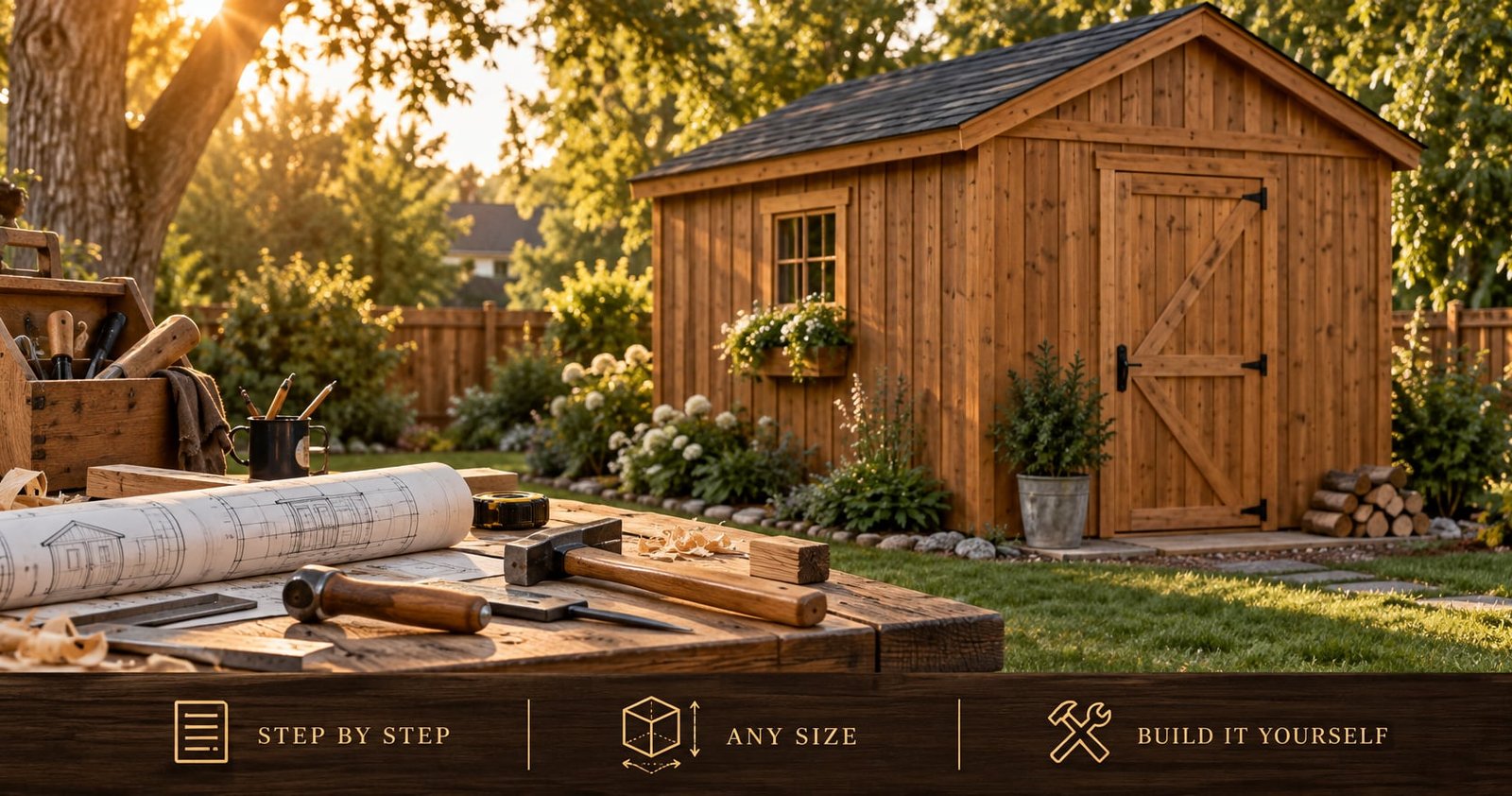
A shed is one of the most satisfying projects a woodworker can take on. It is big enough to feel like a real achievement, useful enough to earn its keep for decades, and simple enough that a determined beginner can build one over a few weekends. The difference between a smooth, enjoyable build and a frustrating one almost always comes down to a single thing: the plan you start with. This guide walks through why building your own shed is worth it, what the build actually involves, how to choose the right design, what separates a good shed plan from a bad one, and where to find plans that make the whole thing easy.
Why build your own shed?
The most obvious reason is cost. A prebuilt shed or a professional installation costs a small fortune, while building the same thing yourself can cost a fraction of that in materials. As a rough guide, the materials for a modest 8 by 10 storage shed might run somewhere around $900, compared to $3,000 or more for a prebuilt one. A larger 12 by 20 shed might cost $1,000 to $1,500 in materials versus close to $5,000 prebuilt. Prices vary with your location and the materials you choose, but the savings are real and substantial.
Beyond the money, building your own means you get exactly the shed you want: the right size for your space, the style that suits your home, and the features you actually need. And there is the simple satisfaction of it. Few projects give you the same pride as standing back and looking at a solid, good-looking building you made with your own hands.
Can a beginner really build a shed?
Yes. A shed is essentially a small building made of straightforward parts: a floor, four walls, and a roof. None of the individual steps is difficult, and with a clear plan guiding you, the whole thing becomes a sequence of simple, manageable tasks. Experienced builders can put up a basic shed in a day, and a complete beginner working carefully might take three to five days. The work is well within reach of anyone willing to measure carefully and follow instructions.
The basic steps of building a shed
Every shed follows the same broad sequence. Understanding it makes the whole project far less intimidating.
1. Plan and check permits. Choose your design and size first, then check whether your local area requires a permit for a structure that size. Sorting this out before you start saves a lot of grief later.
2. Prepare the site and foundation. Pick a level, well-drained spot. Your shed needs a solid, level base, whether that is a gravel pad, concrete blocks, or a timber skid foundation. Getting this flat and square is the most important stage, since everything above it depends on it.
3. Build the floor. A framed floor of joists topped with plywood or OSB gives you a strong, level platform to build on.
4. Frame and raise the walls. Walls are usually framed flat on the ground, then stood up and fixed in place. This is the stage where the shed suddenly starts to look like a building.
5. Build the roof. Rafters or trusses go up, then sheathing, then your chosen roofing. The roof is where a good plan earns its keep, since the angles need to be right.
6. Add siding, doors, and finishing. Siding closes it in, the door and any windows go on, and a coat of paint or stain protects the wood and makes it look sharp.
Each of those steps is simple on its own. The challenge is knowing the exact measurements, the right order, and how the parts fit together, which is exactly what a good plan provides.
Choosing the right shed design
Before you build, think about what you actually need. A few questions help you choose well:
- Size. What will you store or do in it? A small garden shed, a mid-size storage shed, or a large workshop outbuilding are very different projects.
- Style. Do you want a classic gabled shed, a modern flat-roofed design, a barn-style gambrel roof, or something that matches your house?
- Roof type. Gable, gambrel, hip, saltbox, and lean-to roofs each have their own look and complexity. Beginners often start with a simple gable or lean-to.
- Use. Storage, a garden shed, a workshop, or a combination all call for different layouts, door sizes, and window placement.
Matching the design to your real needs and your skill level is what makes for a shed you will be happy with for years.
What makes a good shed plan
This is where most shed projects succeed or fail. A poor plan, with vague steps or missing measurements, will have you making repeat trips to the hardware store, cutting the wrong sizes, and wondering how one stage connects to the next. A good plan removes the guesswork entirely. Look for these features:
- Clear, step-by-step instructions that hold your hand from the foundation to the final coat of paint, with nothing assumed.
- A complete materials and cutting list, so you buy exactly what you need in one trip and know what each piece is for.
- Detailed drawings from every angle, ideally including 3D views, so you can see what each part should look like before you build it.
- Accurate, to-scale measurements, so the parts actually fit together at the end.
- Clarity for beginners, with photos or illustrations rather than dense jargon.
When a plan has all of this, building a shed becomes a pleasure instead of a puzzle. When it is missing, even a simple shed turns into a weekend of frustration.
Where to get good shed plans
You can find free shed plans around the web, and they are a great way to get started on a simple build (we have gathered some in our guide to free shed plans). But if you want a huge range of designs with the level of detail above, a dedicated collection is hard to beat.
One of the most complete is Ryan’s Shed Plans, a library of more than 12,000 shed plans put together by Ryan Henderson, a professional craftsman who has taught thousands of beginners to build their first sheds. It covers every size and style, from compact garden sheds to large workshop outbuildings, and every roof type you might want.
What makes it genuinely useful for a beginner is that every plan includes the features that matter: step-by-step instructions with color photos, complete materials and cutting lists with labels showing what each piece is for, and 3D CAD drawings that show you every part from all angles before you build it. You get lifetime access to the online members area, new plans added regularly, and a “we have it or we’ll get it” promise, where if you cannot find the exact plan you want, their team will draft a custom one for you.
Ordering also includes four bonuses, an advanced woodworking tips guide, a “Magic Modifications” worksheet for resizing any plan to fit your space, a directory of suppliers, and a set of 400 extra woodworking plans. It is a one-time payment of around $37, with no recurring fees, and it is backed by a 60-day money-back guarantee, so you can look through the whole library and decide risk-free. Given that the plans can save you thousands versus buying prebuilt, it pays for itself on your first shed.
A few tips for a smooth build
Whatever plan you use, a handful of habits make the build go better. Read the entire plan before you buy anything, so you understand the whole project. Measure twice and cut once, since a wrong cut on framing lumber wastes money and time. Make sure your foundation is dead level and square before you build up from it. And take your time on the parts that matter most, especially the foundation and the roof. If you are still putting together your toolkit, our guide to the essential tools for beginners will help.
Frequently asked questions
How much does it cost to build a shed yourself? It depends on size and materials, but building your own typically costs far less than buying prebuilt. A small shed might run around $900 in materials versus $3,000 or more prebuilt, and the savings grow with larger sheds.
How long does it take to build a shed? An experienced builder can put up a basic shed in a day, while a beginner working carefully usually takes three to five days. A clear plan is what keeps it on the shorter end.
Can I build a shed with no experience? Yes. A shed is made of simple parts, and with a detailed, beginner-friendly plan, each step is manageable. Thousands of first-time builders have done it.
Do I need a permit to build a shed? It depends on your local rules and the size of the shed. Always check before you start, since requirements vary by area.
Building a shed is one of the best projects you can take on, and with the right plan it is far easier than most people expect. Choose a design that fits your needs, start with a plan that leaves nothing to guesswork, and you will have a solid, good-looking shed to be proud of.