
Affiliate Disclaimer: This post contains affiliate links, and as an Amazon Associate we earn from qualifying purchases. If you buy through our links, we may earn a small commission at no extra cost to you. We only recommend products we genuinely believe you will enjoy.
Few things build a child’s confidence like making something real with their own hands. Woodworking gives kids a break from screens, teaches them patience, measuring, and problem solving, and leaves them with a finished project they are genuinely proud of. Done with the right supervision and the right projects, it is a safe, rewarding activity that many children love, and it can spark a hobby that lasts a lifetime.
This guide covers how to get kids started with woodworking safely, which projects suit which ages, the tools to use, and plenty of simple build ideas. Whether you are a parent, grandparent, or teacher, you will find what you need to make a first project a happy one.
Why woodworking is great for kids
Woodworking teaches a surprising amount. Children practice measuring and counting, they learn to follow steps in order, and they discover how to solve small problems when something does not fit. It builds patience and focus, since a project cannot be rushed. And it is deeply satisfying, because at the end there is a real object they made themselves. That sense of pride, of pointing at a birdhouse or a toy and saying I built that, is powerful and lasting.
It is also quality time. Building something together, side by side, is the kind of shared activity that kids remember. And unlike a lot of hobbies, it does not require expensive equipment to begin.
Safety always comes first
Working with wood and tools means safety has to be the foundation of everything, especially with children. The most important rule is simple: an adult supervises at all times. Kids should never use tools alone, and the level of tool they handle should match their age and maturity.
Give children their own safety glasses and make wearing them a non-negotiable habit from the very first project. Keep the work area clean and clear, teach them to keep their hands away from cutting edges, and let them do the parts they can handle safely while you take on the riskier cuts. Sharp and powered tools stay in adult hands until a child is genuinely old enough and skilled enough, and even then only under close supervision. For a full rundown of safe practices, our woodworking safety guide is worth reading before you start.
Match the project to the age
The right project depends a lot on the child’s age. Younger children, roughly in the early primary years, do best with projects that mostly involve gluing, sanding, painting, and light hammering, with an adult handling any cutting ahead of time. Pre-cut kits are wonderful here, since the child assembles and decorates rather than cutting.
Older children can gradually take on more, such as driving screws with supervision, sanding to shape, and eventually simple sawing with hand tools under close watch. The goal is to give them tasks that are challenging enough to feel like real work but safe enough to succeed at. Start easy, and let them grow into more responsibility as their skills and judgment develop.
Tools that work well for kids
You do not need special child-sized tools, though some lighter tools are easier for small hands. What matters most is choosing tasks and tools that match the child.
Good starting tools for supervised kids include a lightweight hammer for tapping in nails, sandpaper or a sanding block for smoothing, clamps to hold work steady so both their hands are free and safe, and a hand drill or a screwdriver for simple assembly. Always provide safety glasses in a child’s size. Pre-cut project kits are also a great option, since they let a child build and finish a real project without any cutting, which keeps the whole experience safe and frustration-free.
Simple project ideas kids love
The best kids’ projects are quick, useful or fun, and forgiving of imperfection. Here are ideas that tend to be big hits.
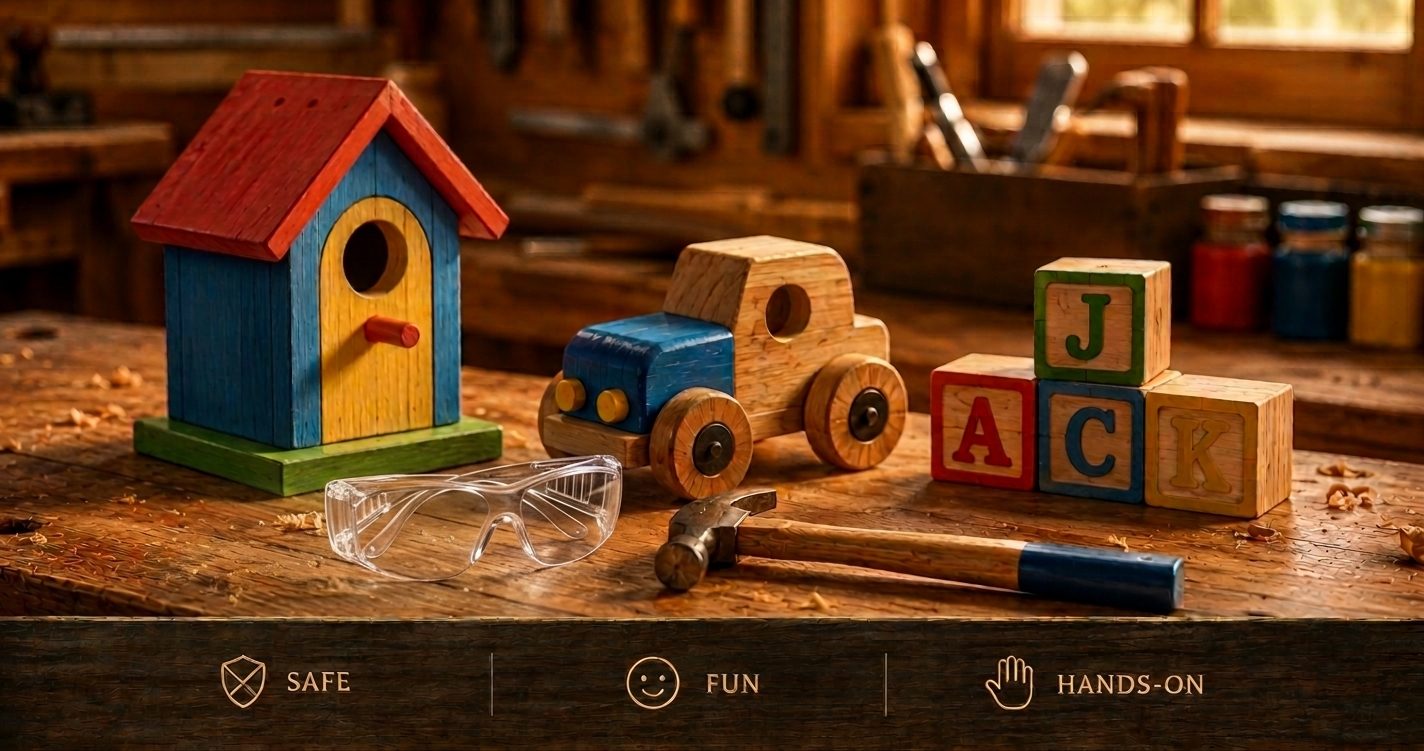
A birdhouse is a classic first build, charming and genuinely useful in the yard. A bird feeder is similar and lets kids watch the results of their work. A simple toolbox or carry tote gives them something to keep their own tools or treasures in. A wooden toy car or boat is pure fun to make and play with. A picture frame or a name plaque lets them personalize and decorate. A small planter box connects woodworking with gardening. And a little treasure box or keepsake box becomes a place to store their favorite things.
Painting and decorating are a huge part of the fun for kids, so choose projects that give them a surface to make their own. A plain birdhouse becomes theirs the moment they paint it their favorite color.
Tips for a great experience
- Let them do the work. It is tempting to step in and make it perfect, but the pride comes from doing it themselves. Let their project look like a kid made it, because that is exactly what makes it special.
- Keep it short and fun. Children have limited patience, so choose projects that finish quickly or can be done in stages. End on a high note rather than pushing until they are tired.
- Manage expectations. Explain that the first try might not be perfect, and that is completely fine. The goal is learning and enjoying, not perfection.
- Praise the effort. Celebrate what they made and the effort they put in. That encouragement is what makes them want to build the next thing.
- Prep ahead. Do the cutting and any risky steps before the child sits down, so their time is spent on the safe, fun parts.
A wonderful activity for grandparents and groups
Woodworking is not just for parents and kids. It is a wonderful thing for grandparents to share too, since it passes down a skill, creates lasting memories, and gives generations something to make together. Many people’s fondest memories are of building something in a grandparent’s garage or shed, and those afternoons stay with a child for life.
It also works beautifully in group settings like classrooms, scout troops, and clubs. Pre-cut kits and simple, repeatable projects let a leader guide several children through the same build safely, and the shared pride of a whole group finishing their projects together is contagious. If you are working with a group, prepare the parts ahead of time, set clear safety rules, and keep the build short enough to finish in one session so everyone leaves with something they made.
Turn it into learning without them noticing
One of the quiet benefits of building with kids is how much they learn along the way, often without realizing it. Measuring a board teaches numbers and fractions. Counting out screws and nails is early math. Following the steps of a plan builds sequencing and planning skills. Fixing a piece that does not quite fit is real problem solving. You do not need to turn the project into a lesson, since the learning happens naturally, but a few gentle questions along the way, like how many more do we need or which piece comes next, turn a fun afternoon into a genuinely educational one.
Make it a regular thing
A single project is great, but woodworking really pays off for kids when it becomes something you return to. Keeping a small box of their own supplies, like sandpaper, safety glasses, and a few offcuts, gives them a sense of ownership and makes it easy to pick up again. Let each project grow a little in challenge as their skills improve, so they feel themselves getting better. Displaying their finished pieces around the house, or letting them give one as a gift, reinforces how proud they should be. Over time, these small builds can grow into a hobby they carry for life.
Finishing kids’ projects safely
For finishing, choose products that are safe for children to use and be around. Water-based paints are easy, colorful, and kid-friendly, and they are the highlight of the project for most children. If you want to seal a piece, pick a finish rated as safe and let it dry and cure fully. For anything a very young child might put in their mouth, be especially careful with both the finish and any small parts. Sanding every edge smooth before finishing keeps little hands splinter-free.
Where to find simple plans
Having a clear, simple plan makes a kids’ project go smoothly, since you can pre-cut the parts and walk through the steps together. Beginner-friendly plans for birdhouses, toys, boxes, and simple furniture give you exact measurements and easy steps, which takes the guesswork out and lets you focus on the child.
A large library of woodworking plans includes plenty of simple, kid-appropriate projects with clear cut lists, so you can pick something suited to your child’s age and prepare it easily. These also make thoughtful gifts, since a handmade toy or birdhouse built with a child is a keepsake families hold onto.
Frequently asked questions
What age can a child start woodworking? Many children can begin around four or five with simple, closely supervised tasks like sanding, gluing, and painting, while an adult handles the cutting. As they grow, they can gradually take on more, but supervision and age-appropriate tasks matter at every stage.
Is woodworking safe for kids? Yes, when it is done with proper supervision, safety glasses, and projects matched to the child’s age. An adult should always be present, and sharp or powered tools stay in adult hands until a child is genuinely old enough and skilled enough to use them safely.
What is the best first project for a child? A birdhouse, a simple toolbox, or a painted toy are all great first builds. They are quick, forgiving, and give the child something fun and useful at the end, which keeps the experience positive.
Do I need special kid-sized tools? Not necessarily. Lighter tools can be easier for small hands, but what matters most is choosing safe tasks and supervising closely. Pre-cut kits are a great way to let kids build without any cutting.
How do I keep them interested? Keep projects short and fun, let them do the work themselves, let them paint and decorate, and celebrate what they make. Ending on a high note and displaying their finished pieces keeps them wanting to build again.
Start building together
Woodworking with kids is about far more than the finished project. It is patience, focus, pride, and time spent together, all wrapped up in something they get to keep. Start with a simple, safe build like a birdhouse or a painted toy, keep safety first, let them do the work, and make it fun. The confidence and the memories you build alongside that little wooden project are the real reward.