Affiliate Disclaimer: This post contains affiliate links, and as an Amazon Associate we earn from qualifying purchases. If you buy through our links, we may earn a small commission at no extra cost to you. We only recommend products we genuinely believe you will enjoy.
One of the biggest worries for anyone starting woodworking is the tools. It is easy to look at a well-stocked workshop and assume you need thousands of dollars of equipment before you can make anything. The truth is much friendlier than that. You can build real, useful, good-looking projects with a small kit of basic tools, and you can add to it slowly as your skills and your projects grow.
This guide walks through the tools a beginner actually needs, what each one does, and the order in which it makes sense to buy them. The goal is not to hand you a giant shopping list. It is to help you build a sensible starter kit without wasting money on things you will not use for years.
Buy quality where it counts, not quantity
Before we get into specific tools, one piece of advice will save you more money than any other. Buy fewer tools, but buy decent ones. A cheap tool that is inaccurate or falls apart will frustrate you, ruin your work, and often end up replaced anyway. That does not mean you need the most expensive brand on the shelf. It means avoiding the bargain-bin stuff and choosing solid, well-reviewed tools that will last.
You also do not have to buy everything at once. Start with the essentials, build a couple of projects, and let your next project tell you what to buy next. Many woodworkers also pick up quality older hand tools secondhand, since the vintage ones were often made to last and can be had for very little at garage sales and flea markets.
Measuring and marking tools
Accurate work starts with accurate measuring and marking, so this is where your kit begins.
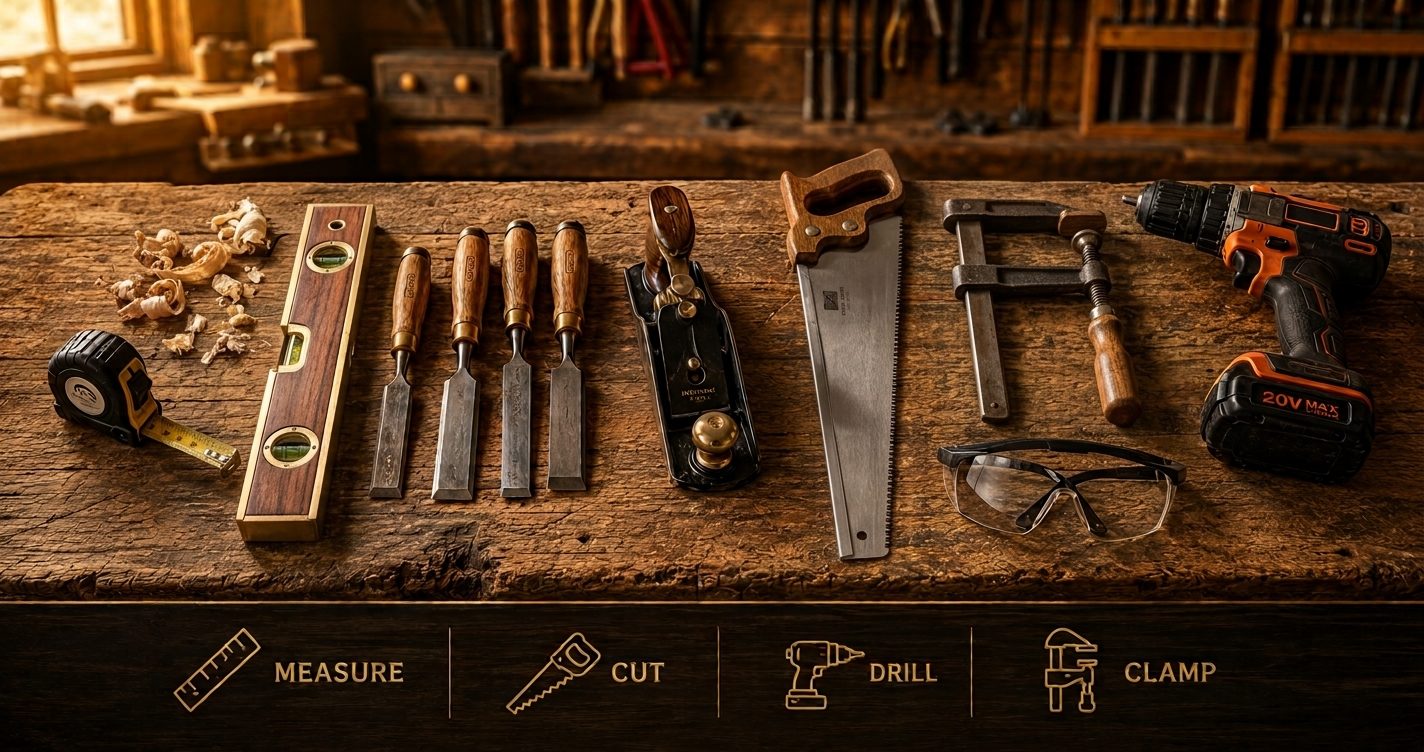
A good tape measure is the first thing you will reach for on almost every project. A sixteen or twenty-five foot tape with a wide, stiff blade works for both small shop work and larger builds. Get one that feels solid, since a flimsy tape that will not stay extended is a constant annoyance.
A combination square or a speed square is next, and it is one of the most useful tools you will own. You use it to mark square lines across a board, to check that your cuts and assemblies are at ninety degrees, and to mark forty-five degree angles. A square is what turns a wonky box into a clean one, so do not skip it.
For marking your cuts, keep a carpenter’s pencil or a regular sharp pencil on hand, and consider a marking knife for fine work. A pencil line has width, while a knife scores a precise line right where the cut should go, which matters for joinery. A small marking gauge is a handy addition later for scribing consistent lines along a board’s edge.
Cutting tools
You cannot get far without a way to cut wood. Even if you plan to buy power saws eventually, a good hand saw is worth having.
A general purpose hand saw lets you cut boards to rough length anywhere, with no power needed. For finer work and curves, a coping saw or a small pull saw gives you more control. Hand saws are quiet, cheap, and safe to learn on, which makes them a great starting point before you move up to power.
A hammer, screwdrivers, and a utility knife
A few basic tools round out the essentials. A claw hammer around sixteen ounces handles nailing and general shop work, and the claw pulls out the nails you inevitably bend. A set of screwdrivers in both Phillips and flat head, in a few sizes, covers hardware and assembly, though many woodworkers reach for a drill with driver bits instead once they have one.
A utility knife earns its keep constantly, from trimming and scoring to opening packages and sharpening pencils. Keep spare blades, since a sharp one is far safer and more useful than a dull one.
Chisels and a block plane
A small set of wood chisels is where your kit starts to feel like a real woodworking setup rather than a general toolbox. Chisels clean up joints, pare away waste, and cut recesses for hinges and hardware. You do not need every size to start. A quarter inch, half inch, and three quarter inch cover most beginner work. Keep them sharp, because a sharp chisel is both safer and far more pleasant to use than a dull one that you have to force.
A block plane is a small, affordable hand plane that does a surprising amount. It smooths rough edges, eases sharp corners, trims pieces to a perfect fit, and cleans up end grain. It is one of those tools that beginners skip and then wish they had bought sooner.
Clamps, and why you can never have too many
Ask any experienced woodworker what they wish they had more of, and the answer is almost always clamps. Clamps hold your work steady while you cut, drill, or carve, and they hold glued pieces together while the glue dries. Because you cannot grow extra hands, clamps are what let you work safely and accurately on your own.
Start with a few of a couple of types, such as some bar or F-style clamps for general work and a few smaller quick-grip clamps for lighter jobs. You will use them on nearly every project, so pick up more whenever you find them at a good price. A bench vise mounted to your workbench is another excellent way to hold work firmly while you shape it.
The first power tools to buy
Power tools are not required to start, but they make many jobs faster and easier. If you are going to buy them, here is a sensible order.
A cordless drill and driver is the first power tool almost everyone should own. It drills holes and drives screws, and with the right bits it does far more. A drill turns slow, tiring hand work into quick, easy work, and you will use it on nearly every build. Buy a set of drill bits and driver bits to go with it.
Next, a saw. A jigsaw is beginner friendly, versatile, and good for curves and general cuts. A circular saw is better for cutting straight lines and breaking down larger boards and sheet goods, especially paired with a straightedge guide. Either one is a fine first powered saw, and which you choose depends on the kind of projects you want to make.
A random orbital sander is the third power tool worth adding early. Sanding by hand is slow and tiring, and a sander gives you a smooth, even finish in a fraction of the time. Keep a range of sandpaper grits on hand, from coarse for shaping to fine for finishing.
Beyond these three, a router opens up edge profiles, grooves, and joinery, and a table saw becomes worth it once you are building furniture and cutting a lot of straight, repeatable pieces. Both are wonderful tools, but neither is a first purchase. Add them when your projects call for them.
Do not forget safety gear
Safety equipment is not optional, and it belongs in your very first kit. At a minimum you want safety glasses to protect your eyes from flying chips and dust, hearing protection for when you run loud power tools, and a dust mask or respirator for sanding and cutting, since fine wood dust is not something you want in your lungs. It is inexpensive, and it protects the parts of you that you cannot replace. For a full rundown, see our woodworking safety guide.
Keep your tools sharp and cared for
A tool is only as good as its edge and its condition. Dull chisels, plane blades, and saws are more dangerous and produce worse results than sharp ones, because they force you to push harder and they slip. A basic sharpening stone or sharpening system is a small investment that keeps your cutting tools working well for years. Wipe metal tools down to prevent rust, keep them somewhere dry, and store edges protected so they do not get dinged.
A sensible beginner starter kit
If you want a simple list to start from, here is a kit that will carry you through a wide range of beginner projects without breaking the bank. A tape measure, a combination square, pencils and a marking knife, a hand saw, a hammer, a set of screwdrivers, a utility knife, a small set of chisels, a block plane, a handful of clamps, and safety gear. Add a cordless drill, a jigsaw or circular saw, and a random orbital sander when you are ready to bring in power tools.
That kit is enough to build shelves, boxes, small furniture, and plenty more. Everything beyond it is a matter of adding tools as specific projects call for them, which is exactly how most woodworkers grow their shops.
Where to buy your tools
You have a few good options for buying tools, and mixing them saves money. General retailers and online stores are convenient and cover most of the basics, often at good prices, which is fine for many beginner tools. Dedicated woodworking suppliers carry higher-quality hand tools, chisels, planes, and specialty items, and their staff know their products, which is worth it when you want something that will last. And do not overlook the secondhand market, since garage sales, flea markets, and estate sales are full of quality older hand tools, often made better than today’s budget versions and available for very little. A vintage hand plane or a set of old chisels, cleaned up and sharpened, can outperform new bargain tools for a fraction of the cost.
Tools you can skip for now
Just as useful as knowing what to buy is knowing what to leave on the shelf. Beginners often feel pressure to buy big, expensive machines right away, but most are not needed at the start. A table saw, a planer, a jointer, a band saw, and a drill press are all wonderful tools, but they are purchases for when your projects specifically call for them, not for day one. The same goes for large, specialized sets of anything. Buying these too early ties up money you could spend on wood and the tools you will actually use, and they take up space while you learn. Add the big machines when a project you want to build genuinely needs one, and you will buy the right tool for the right reason.
Build your kit as you build your skills
The best approach to buying tools is a patient one. Get the essentials, make something, and enjoy it. When you hit a project that needs a tool you do not have, that is the moment to buy it, because now you know exactly why you need it and what to look for. This keeps your money going toward tools you will actually use, and it spreads the cost out over time.
Woodworking is not about owning the most tools. It is about learning to use a few of them well. Start small, buy quality where it counts, keep your edges sharp, protect yourself, and let your growing collection of finished projects guide what comes next. Before long you will have both a shop full of tools you love and the skills to put every one of them to good use.